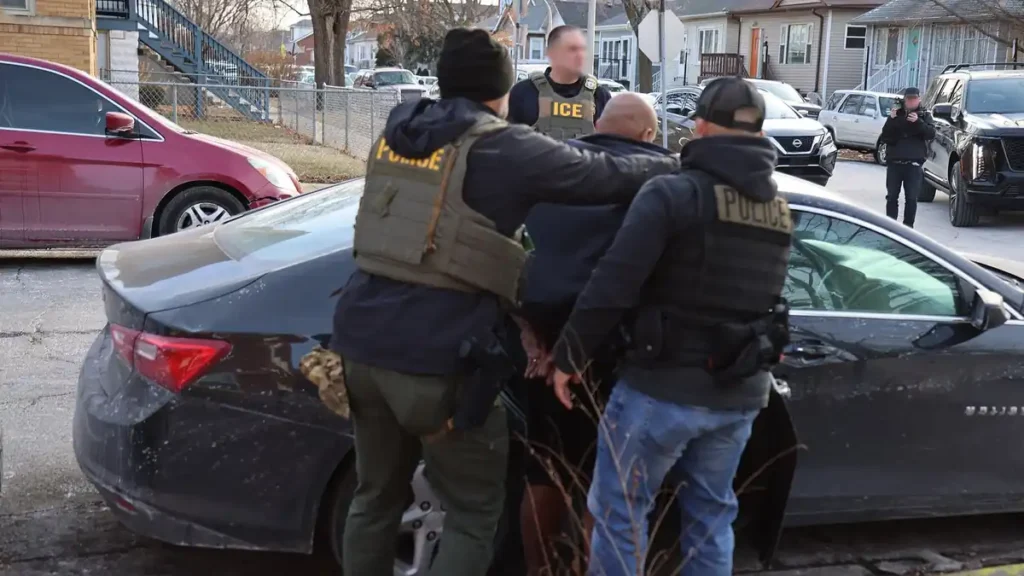
An ICE officer faces a state indictment that could reshape how federal immunity protects enforcement agents. Harris County District Attorney Sean Teare announced charges against Mario Alberto Morales for aggravated assault with a deadly weapon after surveillance video showed his SUV striking Miguel Parra Hernández during an October 10 operation in west Houston. The case tests whether federal authority shields an officer when a local prosecutor argues the harm was intentional, not incidental.
On October 30, a Harris County grand jury indicted ICE officer Mario Alberto Morales for aggravated assault with a deadly weapon. The charge stems from an October 10 enforcement operation in west Houston where Morales’s vehicle struck Miguel Parra Hernández, 48. Parra Hernández suffered a leg broken in three places requiring emergency surgery and ongoing orthopedic treatment. Morales was placed on administrative leave. The indictment marks the first time a Texas prosecutor has charged an ICE officer for actions during an enforcement operation.
Immigration attorneys in Texas face new precedent risk: a state prosecutor is indicting a federal officer for actions taken during official enforcement. Morales’s defense will hinge on federal immunity doctrine, but the grand jury’s decision signals that state courts may limit that immunity when evidence of intentional (not merely negligent) harm exists. If Teare’s team proves intent via video, Morales’s federal status may not shield him — a shift that could expose ICE officers to state prosecution in other jurisdictions.
Federal immunity doctrine stems from the Constitution’s Supremacy Clause. The rule: a federal officer acting within official authority cannot be sued in state court. But the doctrine has limits. Federal immunity does not shield actions taken knowingly unlawfully or recklessly. In Texas, aggravated assault with a deadly weapon requires proof of intent or recklessness. Teare’s case rests on video evidence. According to the district attorney, surveillance shows Morales moved his vehicle deliberately toward Parra Hernández. If that intent is proven, federal immunity may fail.
The Operation Itself Was Flawed
The operation’s context complicates Morales’s defense. According to FIEL Houston, the ICE enforcement operation targeted a man in the agency’s deportation database. But that man died in 2017. ICE’s warrant system was not updated. If Morales executed a flawed operation—one based on a deceased subject—accountability shifts from officer to system. Additionally, Teare stated that DHS and ICE did not cooperate with state investigators. ICE declined consent and removed the vehicle before state investigators could execute a search warrant, preventing crash-data extraction. Teare framed this as obstruction, putting federal enforcement at odds with state law enforcement.
The Morales indictment is part of a larger pattern. In 2026, at least three ICE and CBP officers face assault charges: Minnesota (Gregory Donnell Morgan Jr.), Colorado (Nicholas Rice), and Houston (Morales). State prosecutors and juries appear willing to indict federal officers when evidence of intentional harm exists. This trend shapes ICE accountability across jurisdictions. Morales’s defense will file a federal immunity motion, arguing Texas has no authority to prosecute him. That motion will determine the case’s outcome. If granted, the case ends. If denied, conviction becomes possible. An appellate court may create precedent on state power to prosecute federal officers.
The operation targeting failure undercuts Morales’s defense. The grand jury indicted Morales for striking a man during an enforcement operation. But ICE’s own warrant database failed: the operation targeted a deportation subject who died in 2017. This suggests systemic negligence, not isolated officer error. If Morales was executing a flawed operation, accountability questions shift from the officer to the system. A jury may see him not as a rogue actor, but as someone following a broken process. The warrant database failure matters because it frames the case beyond individual conduct.
What happened to the man hit by the ICE vehicle in Houston? Miguel Parra Hernández, 48, was struck by an ICE officer’s SUV on October 10 in west Houston during an enforcement operation. His leg was broken in three places and required emergency surgery. He faces ongoing orthopedic treatment. The officer, Mario Alberto Morales, has been charged with aggravated assault with a deadly weapon. Morales was placed on administrative leave while awaiting trial.
Source: NBC News indictment announcement | PBS NewsHour on DA Teare’s statement
The Morales case tests whether federal immunity withstands state prosecution built on video evidence of intent. Watch for Morales’s federal immunity motion—the filing will reveal his defense strategy. CruxBuzz will update this story as the legal strategy unfolds and as the federal government decides whether to open a parallel investigation. For immigration attorneys, this case will define federal officer accountability for the next two years.