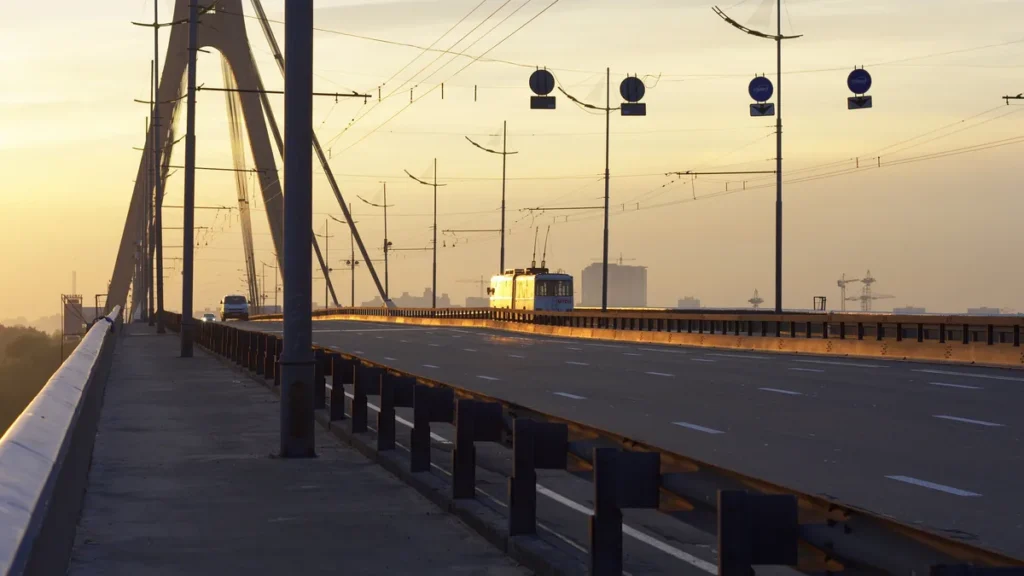
Kyiv’s two main road bridges over the Dnipro River were closed on Tuesday after Russian ballistic missile strikes hit the capital, officials said, suspending part of the metro and cutting water and heating in some districts.
Mayor Vitali Klitschko said the Northern and Southern bridges, two of the three main crossings between the city’s left and right banks, were shut after the overnight attack. Loud explosions were heard just before midnight, and the mayor said the city had suffered damage to critical infrastructure systems. Eight major bridges span the Dnipro in Kyiv, and an estimated three million residents rely on them to travel across the city, according to the BBC.
The closures cut the fastest routes between the two banks at the start of the working week. Commuters faced long detours, and Green Line metro services on the section serving the eastern bank were suspended because above-ground infrastructure was damaged, the Kyiv Post reported. Underground stations remained open as air-raid shelters, and city authorities had not said when the bridges would reopen.
For readers in Kyiv, the practical question is how long the crossings stay shut. The city has begun building backup crossings, and the first is expected to become operational in early 2027, Infrastructure Minister Mykola Kalashnyk said.
A campaign against the city’s river crossings
The overnight strikes were the latest in a series of attacks on Kyiv’s bridges since early October. Russian drones hit the South Bridge on 1-2 October, damaged the North Bridge’s road surface on 3 October, and struck the South Bridge again on 27 October, forcing repeated closures and traffic jams. The Institute for the Study of War, a US research group, said in its 14 November assessment that Russia’s intensified bridge attacks could be aimed at disrupting transport and splitting the capital’s electricity network along the Dnipro.
Russia’s defence ministry said its air defences intercepted and destroyed 2,049 drones and four Flamingo long-distance missiles over 24 hours. Moscow’s mayor, Sergey Sobyanin, said about 600 drones flew towards the capital. Three people were injured in Smila, in the Cherkasy region, and strikes were reported in Kharkiv and Zaporizhzhia, local officials said.
The attacks on Kyiv came a day after Ukraine’s latest attempt to disable the Kerch Bridge, the road-and-rail link between Russia and occupied Crimea. The Moscow-backed governor of Crimea, Sergei Aksyonov, said traffic over the bridge had been suspended. Former Ukrainian adviser Anton Gerashchenko shared images that appeared to show a support arch and a road section collapsed in the water; the BBC said it had not independently verified those images.
Ukrainian officials also said the final death toll from a Russian attack on the southern village of Komyshuvakha this month had reached 72, with four people unaccounted for. The 2 November strike hit a shelter where residents had fled, Ukrainian officials say, and used what they described as a 3,000kg aerial bomb.
President Volodymyr Zelensky had warned that Ukrainian intelligence had identified Russian plans for further attacks on Monday evening and Tuesday. He has long called for European nations to join negotiations, and said Moscow is receiving “dozens of missiles per month” from North Korea.
The strikes add pressure on Ukrainian defences at a delicate moment in diplomacy. US, Ukrainian and European officials met this week to discuss direct engagement between Russia and Europe. US envoy Jared Kushner said Washington would provide Ukraine with “strong, credible security guarantees” and support a path towards EU membership. Zelensky called the meeting “difficult” and said more needed to be done to defend against Russian ballistic missile strikes.