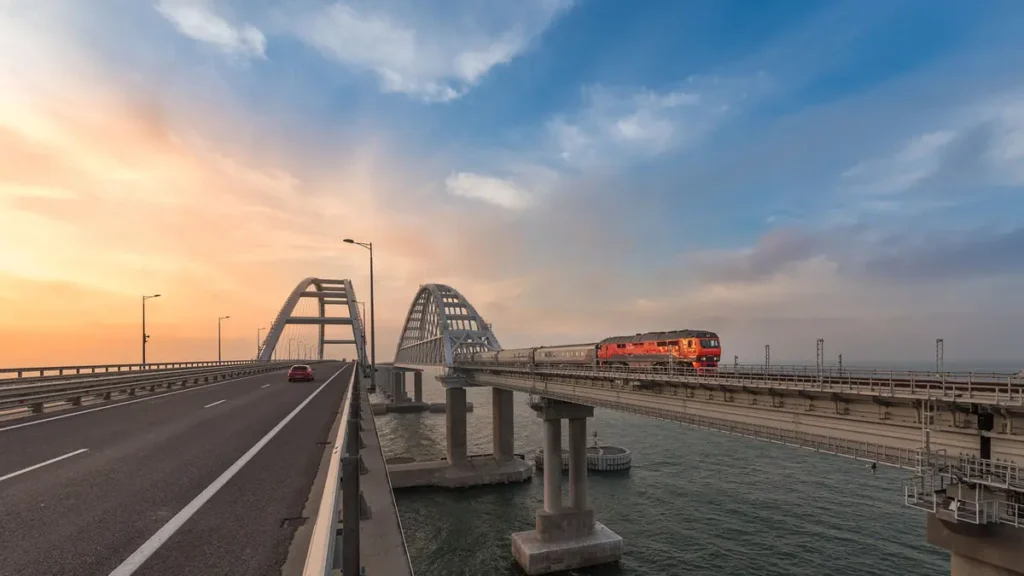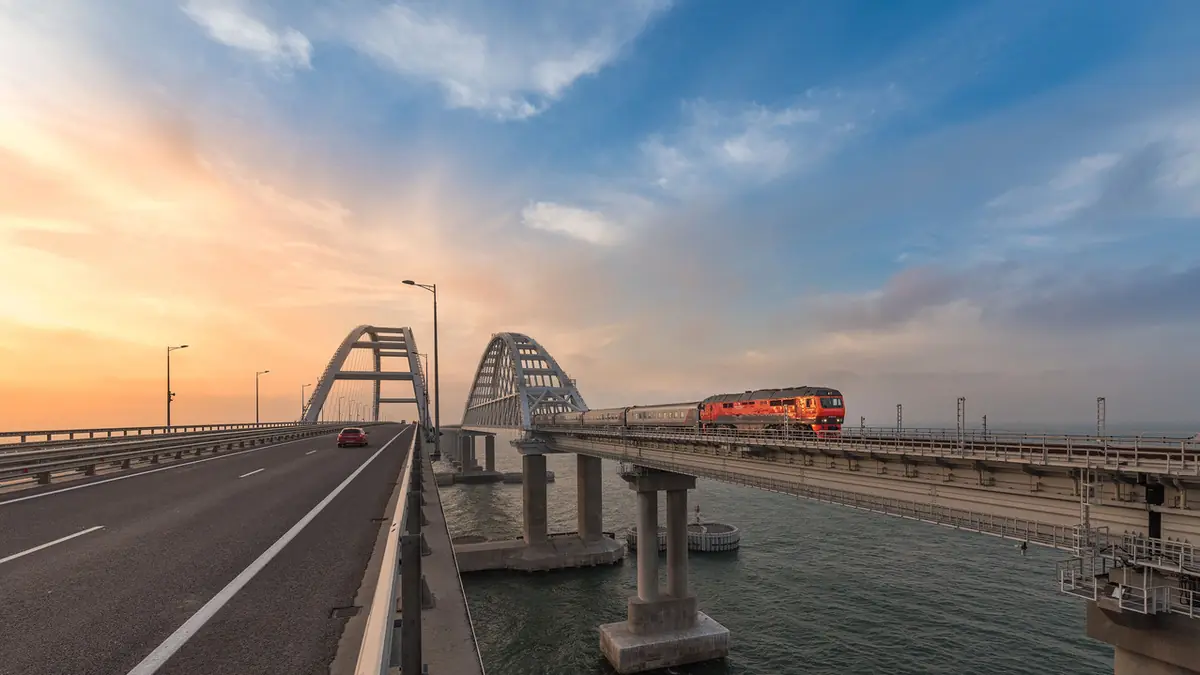
A 227m road arch of the Crimean Bridge has collapsed into the Kerch Strait, dragging about 200m of tarmac into the sea after a seven-stage Ukrainian missile and drone operation, Ukrainian officials said. President Volodymyr Zelensky called it an unprecedented operation weeks in the making. The bridge is the main road and rail link between Russia and occupied Crimea.
Ukraine’s military said the roadway is out of action and no vehicle can cross it. The railway section is still standing, but its supporting arch was damaged, and Russia’s transport ministry later said some rail services had resumed. Russia’s Investigative Committee confirmed structural damage and opened a criminal case on terrorism charges. Zelensky said the operation unfolded in seven stages, with Ukrainian forces first destroying air defence systems, radars and electronic warfare equipment over several weeks. Several types of Ukrainian drones, plus Flamingo and Neptune cruise missiles, were fired in the final phase. Russia’s defence ministry said 2,256 Ukrainian drones were downed in the biggest drone attack since the war began. An earlier drone barrage on the Kerch crossing on 16 November had damaged the road arch and halted traffic, but the structure remained standing.
For Russia, the road closure removes the shortest route into Crimea for fuel, food and military equipment. Moscow can still use a land corridor through occupied Zaporizhzhia and Kherson, and a ferry across the Kerch Strait, which could partly compensate. The rail line is carrying what it can. Engineers told the BBC that clearing the wreckage could be quick, but reinstating full road traffic would take over a year, and that rebuilding within range of Ukrainian weapons is hard to envisage.
How the operation unfolded
The shaping phase is what distinguishes this strike from earlier attacks on the bridge. Ukrainian forces spent several weeks hitting air defence systems, radars and electronic warfare assets, then struck the bridge itself in the early hours of 17 November. One verified video, filmed from a camera on board a Ukrainian-made Flamingo missile, shows the weapon approaching the main span and heading towards the steel arches, with the footage freezing just before impact. Munitions expert Justin Bronk of the Royal United Services Institute said the missile’s heavy warhead made it more suitable for attacking the bridge’s reinforced concrete spans and supports. Engineers said the road arch that fell weighed thousands of tonnes and measured about 227m, and that the arch played a structural role in supporting the whole span.
The bridge cost $3.6bn (£2.7bn), was built by Arkady Rotenberg, a businessman close to Putin, and was opened by Putin driving a lorry over it in May 2018, after Russia’s 2014 annexation of Crimea. The strike comes days before Putin meets Donald Trump and Xi Jinping in Shenzhen. In the same week, Russian missiles hit two of Kyiv’s bridges, and Zelensky has said Western satellite limits are still slowing Ukraine’s drone campaign.
What changed this time is the structure. Engineers told BBC Verify that the damage to the main span is catastrophic and that full road traffic could take over a year to restore. The BBC reported that images shared by Ukrainian officials show a section of the bridge collapsed into the water, and a second BBC Verify account reconstructed the seven-stage operation.
Kremlin spokesman Dmitry Peskov said the bridge would be restored and even better than before, without giving a timeline, and did not rule out a link to Putin’s visit to China. The indicators to watch are Russia’s repair claims, whether rail traffic can absorb the load, and any reference to the bridge when the Shenzhen summit opens.