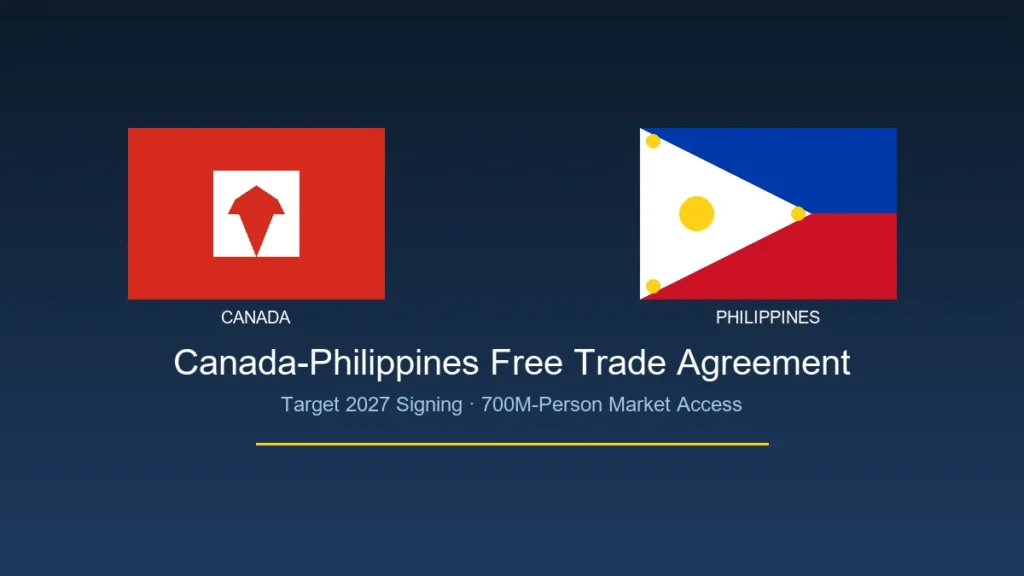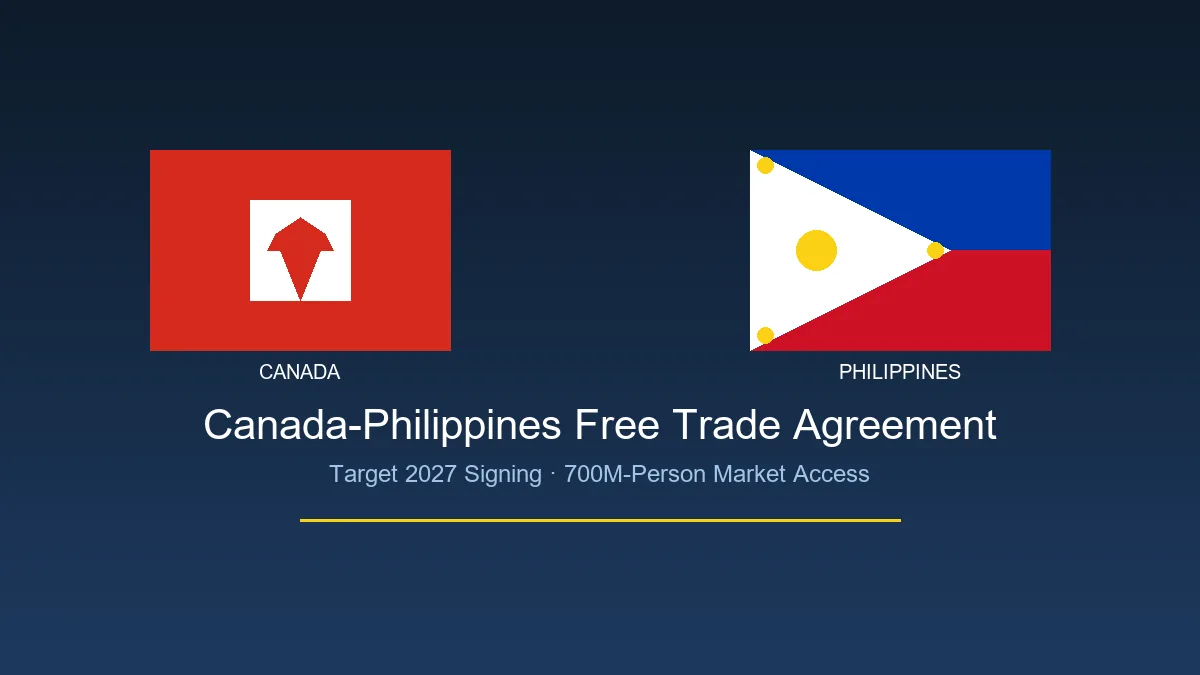
Canada and Philippines Seal Free Trade Talks
Canada has wrapped free trade negotiations with the Philippines, unlocking a combined Southeast Asian market of more than 700 million people alongside a parallel ASEAN agreement. Prime Minister Mark Carney announced the conclusion of talks on November 14, 2026, targeting a formal signing in 2027. The bilateral deal with the Philippines and the regional deal with the 10-member ASEAN bloc were finalized on the same day — a signal that Ottawa is treating Southeast Asia as a single economic bloc rather than pursuing piecemeal bilateral agreements.
Core Facts: What Was Agreed
Negotiations for the Canada-Philippines Free Trade Agreement launched in March 2024 and concluded in November 2026. Two-way merchandise trade reached $2.1 billion in 2025, making the Philippines Canada’s 24th largest trading partner. The agreement covers tariff elimination on agriculture, clean technology, digital trade, and services. Rules of origin, labor standards, and environment chapters are included, aligning with Canada’s recent trade agreements such as CPTPP.
Simultaneously, Canada concluded negotiations for a Canada-ASEAN Free Trade Agreement. ASEAN represents 10 Southeast Asian nations — Indonesia, Malaysia, Philippines, Singapore, Thailand, Brunei, Vietnam, Laos, Myanmar, and Cambodia — with a combined population of over 650 million and GDP exceeding $3.6 trillion. The dual conclusion unlocks a combined market of more than 700 million people for Canadian businesses.
Why This Matters for Canadian Exporters
For Canadian exporters, this opens a market of 115 million Filipino consumers and, combined with the parallel ASEAN deal, 700 million people across Southeast Asia. Tariff elimination on agriculture, clean tech, and digital services means lower costs for Canadian goods entering the Philippines and easier entry for Philippine products into Canada. For Filipino-Canadians, it strengthens economic ties to a homeland that sends over $2 billion in remittances annually. The 2027 target gives businesses a clear timeline to prepare supply chains and certifications.
Key Canadian export sectors poised to benefit include pork, wheat, and pulses — already significant in the Philippines market — along with clean technology solutions for the Philippines’ energy transition and digital services for its growing business process outsourcing sector. Philippine exports to Canada, led by electronics, semiconductors, and agricultural products, gain improved access to North American supply chains.
The agreement also includes a digital trade chapter addressing data localization, cross-border data flows, and electronic commerce — provisions that reflect the Philippines’ position as a global BPO hub and Canada’s push for digital economy rules. Services market access covers professional services, financial services, and telecommunications, with commitments that go beyond WTO baseline obligations.
Strategic Pivot to Southeast Asia
The dual conclusion — Philippines bilateral and ASEAN regional — on the same day signals Canada’s strategic pivot to Southeast Asia as a single economic bloc rather than bilateral piecemealing. ASEAN’s combined GDP makes it the fifth-largest economy globally, projected to be the fourth-largest by 2030. Canada’s trade with ASEAN reached $38.6 billion in 2025. The FTA positions Canadian firms to compete with rivals from the U.S., EU, Japan, and China, all of whom have existing ASEAN trade frameworks.
For the Philippines, the deal diversifies trade beyond its traditional partners — China, Japan, the U.S., and the EU — and locks in preferential access to Canadian raw materials and technology. Manila has pursued an active trade agenda under the Marcos administration, including RCEP ratification and bilateral talks with the EU and UK.
What Comes Next
Text finalization and legal review continue through 2026. Parliamentary ratification in both countries is needed before the 2027 signing. Businesses should audit supply chains now for rules-of-origin compliance — particularly for automotive, agri-food, and textile sectors where regional value content thresholds will determine tariff eligibility. The Philippines will need to align domestic regulations on data governance and professional licensing to meet the agreement’s services commitments.