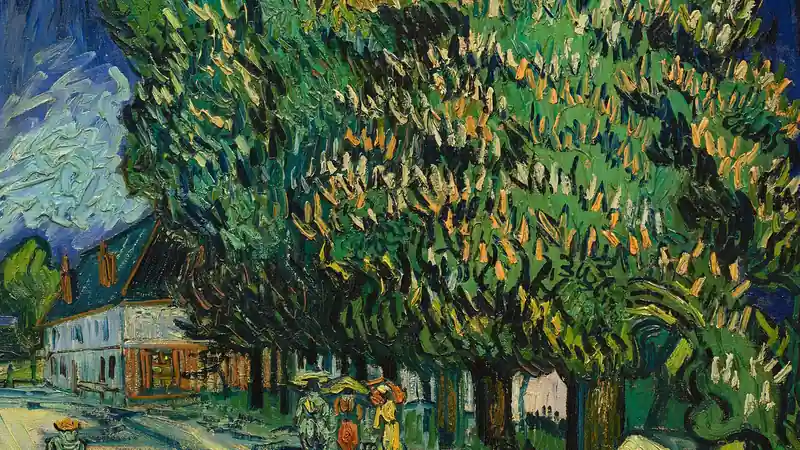
A Vincent van Gogh painting that a Jewish family sold under Nazi persecution has just set an auction record. Chataigniers en fleurs fetched $190.4 million at Sotheby’s in New York on Wednesday, ending a legal fight over whether the family’s 1936 sale was truly voluntary.
Vincent van Gogh’s Chataigniers en fleurs sold Wednesday at Sotheby’s in New York for $190.4 million. This Van Gogh record sale shattered the previous auction record of $117.2 million, set in November 2022. The final price also reached £144.9 million and roughly A$285 million.
Sotheby’s did not name the buyer in its press statement. The New York Times later reported that William Acquavella, a veteran art dealer and head of Acquavella Galleries, made the purchase. The sale was the second-highest price paid for any work of art sold by Sotheby’s, behind Gustav Klimt’s “Portrait of Elisabeth Lederer,” which sold for $236.4 million in November 2025.
The painting, also known as Chestnut Trees in Blossom, dates from 1890. Van Gogh painted it days after arriving in Auvers-sur-Oise, a small hamlet northwest of Paris. He spent the final two months of his life there. The composition shows a row of flowering chestnut trees lining a village road, with a solitary male figure in a hat walking past three women carrying parasols. The figure is thought to possibly represent the artist himself. The work had not been publicly displayed for more than 50 years before this sale.
Van Gogh painted the canvas in the final weeks of his life. Its brushwork connects it to other celebrated works from the same period, including “The Starry Night” and “The Church at Auvers-sur-Oise.” The previous auction record for a Van Gogh had stood since November 2022.
The Blaquier-Arrieta family acquired the painting in 1975 and owned it for over half a century. Its earlier history carries the weight of wartime tragedy.
Wartime Dispossession
Samuel Fischer, a prominent German publisher, purchased the work in Paris in 1909. Fischer’s family sold the painting in 1936. They said they parted with it only because of severe financial losses suffered under the Nazi regime. This Nazi-era ownership dispute became central to the sale’s controversy.
When Sotheby’s announced plans to auction the work, Fischer’s legal descendants objected. Their lawyer, Gunnar Schnabel, who is based in Berlin, called on Sotheby’s to prove the 1936 sale was voluntary and that the painting had fetched its market value at the time. The family argued that fear and financial desperation, not genuine willingness, had motivated the original sale.
On Tuesday, the day before the auction, Sotheby’s announced an agreement. The house stated that “an agreement has been reached between the Blaquier-Arrieta family and all of the legal descendants of Hedwig and Samuel Fischer regarding the sale of Vincent van Gogh’s Chataigniers en fleurs.” The resolution allowed the sale to proceed.
After the gavel came down, Schnabel described the mood in the room as “no Champagne atmosphere.” The Fischer heirs said they were “grateful for the trusting and fair negotiation and collaboration with Sotheby’s and the Blaquier-Arrieta family, which make it possible to acknowledge the suffering of the Fischer family during the Nazi era and honor Gisela Berman Fischer’s history of seeking justice for her family.” Schnabel said the family hoped that “the considerable public interest in this case, and its fast and fair and just resolution, may offer some encouragement to other families who have faced persecution during the Nazi era.”
The case is one of a series of disputes over works sold under duress during the Nazi era. Schnabel said he hoped the resolution would encourage other families. For the art market, the settlement removed a legal cloud that had threatened to block the sale.
Celebration is only one part of the arts world. Alongside events such as the Kennedy Center Honors and Eurovision Asia, auction houses also settle ownership disputes before a gavel falls. For the Fischer family, the record sale closed a chapter that began in 1936.