Four tankers on fire in Strait of Hormuz: Environmental and market risks escalate
Four tankers caught fire in the Strait of Hormuz after reported mine strikes—21 billion liters of crude and refined fuel at risk. Here’s what a major spill would mean for the global oil market and maritime commerce.
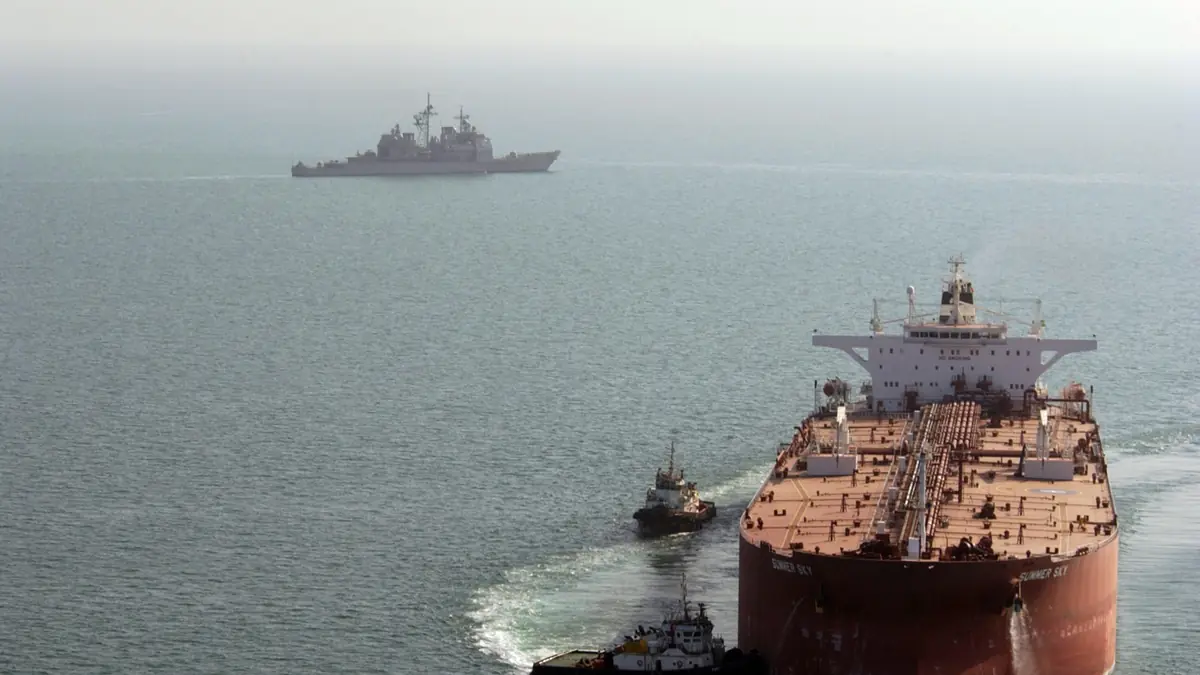
Iran’s navy reported Thursday that mines struck four commercial tankers in the strategically critical waterway that controls one-third of global maritime petroleum flows. The vessels caught fire after impact. No crew deaths were reported as of Thursday evening, but rescue operations were still underway.
If all four tankers fully breach, 5.5 billion gallons of crude and refined fuels would spill into the Persian Gulf. That quantity would be approximately 500 times larger than the 1989 Exxon Valdez disaster, which spilled roughly 11 million gallons. Traders, insurers, and shipping risk officers across London, New York, and Sydney now assess an unforgiving timeline: unclear containment duration, rerouted shipping, and cascading port and insurance disruption.
What Happened: The Incident Timeline
Iranian authorities reported the first strike around 10:00 AM local time. A second tanker caught fire within 30 minutes. Two additional vessels reported impact and fire within the hour.
Iran’s state media blamed “previously laid mines” for the explosions. The Islamic Revolutionary Guard Corps (IRGC) said it had deployed rescue vessels and helicopter support. International maritime authorities, including the US Navy’s Fifth Fleet, have not independently verified mine origin.
Crew counts ranged from 18 to 28 sailors per vessel. Turkish, Indian, and Filipino nationals comprise most crews, according to shipping registries. By Thursday evening, Turkish authorities said their nationals aboard two vessels had been evacuated. Status of Indian and Filipino crews remained uncertain.
Three of the four tankers remain ablaze as of Thursday night. Firefighting equipment on scene has proved inadequate for crude oil fires of this scale. Salvage teams were staging out of Sharjah, a 45-minute transit away. Iran estimated fire suppression operations could take 12–72 hours depending on fuel type and tanker structural integrity.
Why This Threatens Shipping Economics and Insurance Markets
An uncontrolled spill of this magnitude disrupts Hormuz shipping for weeks to months. Here’s why traders and risk officers must assess exposure.
First, closure duration. Supertankers carry 2 million barrels per day through the strait during normal operations. A major spill triggers emergency closure of traffic lanes, pilot uncertainty, and insurance refusals. The 2019 Fujairah incident, which affected multiple vessels, reduced transit flow for several weeks.
Second, rerouting cost. Vessels detoured via the Cape of Good Hope add 6,000 nautical miles and 14–18 extra days at sea. Per-vessel operating cost rises substantially. Traders hedging tanker scheduling for November and December must now account for rerouting probability.
Third, insurance disruption. Underwriters are reviewing war-risk and pollution-liability policies on Hormuz-bound vessels. Some insurers have issued force majeure notices to clients. If salvage operations fail and containment collapses, insurers face significant environmental cleanup liability. This will trigger broad policy reviews through the remainder of 2026.
Environmental Sensitivity: Why 21 Billion Liters in the Persian Gulf Matters
The Persian Gulf is the world’s most sensitive maritime zone for environmental spillage. Desalination plants feed drinking water to 50 million people across Saudi Arabia, United Arab Emirates, and Qatar. An unrecovered crude spill deposits persistent hydrocarbons in seawater for 18–36 months.
Seawater temperature accelerates evaporation in the Gulf, but salinity and high-velocity current patterns disperse oil plumes into fisheries and desalination intakes within hours. Environmental recovery from major spills in the region requires extended cleanup operations.
A full 21-billion-liter spill would trigger environmental liability claims from Gulf Cooperation Council nations, fishing industry associations, and desalination operators. That liability flows to vessel owners and charterers. UK and US insurers will demand policy review before renewing coverage through 2027.
Crew Risk and Salvage Operations
Salvage operations in mine-strike zones expose rescue personnel to secondary explosions and environmental hazard. Private salvage operations for Persian Gulf fire suppression are costly and logistically complex.
If rescue crews cannot suppress fires within 48 hours, tanker hulls cool and cement as wreck hazards. That forces permanent containment buoys and ongoing surveillance, adding substantial multi-year operational cost.
Crews aboard burning tankers face vapor inhalation and thermal exposure. Turkish, Indian, and Filipino maritime unions have already signaled they will demand compensation and repatriation for exposed crew members. Future recruitment for Hormuz-route vessels may face tighter labor conditions through 2027.
Trading Desk Implications: Futures, Spreads, and Risk
Oil futures markets have already priced in probability of a Hormuz closure. Brent crude spiked $2.30 per barrel Thursday afternoon. WTI (West Texas Intermediate) climbed $1.95 per barrel on US markets. Those moves reflect physical shortage risk.
The real trading-desk impact flows through time spreads and counterparty exposure. Traders holding short-dated Hormuz-dependent contracts face margin adjustment as forward premiums widen. Tanker-charter spreads typically widen during periods of mine or missile activity.
London brokers report active hedging: traders buying OTC (over-the-counter) call options on insurance premiums to lock in protection. Credit desks are issuing alerts on counterparty exposure.
Risk Quantification
Q: How much oil is at risk of spilling?
A: If all four tankers fully breach, 21 billion liters (5.5 billion gallons) could spill into the Persian Gulf. Worst-case containment failure leaves a significant portion unrecovered due to seawater dispersal and environmental conditions. Historical precedent: The Erika tanker spill in 1999 discharged approximately 19-21 million liters into the Bay of Biscay. A major spill in the Persian Gulf would trigger substantial environmental cleanup operations.
Why This Matters Now
Tanker scheduling for November and December through Hormuz is active. Traders are pricing risk into forward contracts. Insurers are reviewing policy terms and force majeure triggers.
The decision window is tight: 7–10 days. Within that window, salvage teams will confirm containment feasibility. Crew rescue status will clarify. Iran and international authorities will establish incident attribution and escalation risk. That clarity will set insurance rates, rerouting economics, and portfolio strategy through year-end.
Risk officers cannot wait for final incident reports. Exposure decisions must be made immediately, before insurer capacity becomes unavailable and rerouting options evaporate. Tanker owners and charterers should model Cape of Good Hope routing and request updated quotes today. Energy traders holding Hormuz-dependent positions should reassess hedges and counterparty limits within 48 hours.
The 21 billion liters at risk are not abstract. They flow into desalination plants, trading desks, and insurance portfolios. Your exposure is live.