Iran Attacks Bahrain Radar That Links Gulf THAAD to Israel’s Arrow-3
Bahraini civilians in Muharraq and Manama woke to air-raid sirens and intercept debris before dawn on November 15 — the first time since 1991. At NSA Bahrain, 9,000 U.S. personnel and the Navy’s 5th Fleet headquarters went to force-protection Bravo. For the defense-industry program manager watching Slack alerts, the question was sharper: does the overnight IRGC salvo invalidate the single-point-of-failure assumption for the AN/TPY-2 radar that stitches together missile defense for three nations?
Iran’s Islamic Revolutionary Guard Corps Aerospace Force launched multiple ballistic missiles and one-way attack drones at Naval Support Activity Bahrain around 0230 local time on November 15, explicitly targeting the AN/TPY-2 X-band radar deployed there since 2019 and upgraded in 2023. CENTCOM confirmed integrated air defenses — Patriot and THAAD batteries — engaged and destroyed all inbound threats with no U.S. casualties or damage to ships and infrastructure. Bahrain’s Ministry of Interior stated air defense forces intercepted “hostile aerial targets over territorial waters” with civilian areas unaffected. The IRGC framed the operation as “True Promise III,” claiming it targeted a “Zionist-American spy radar” guiding Israeli and American missile defenses. The White House condemned the “reckless escalation” and redirected a carrier strike group to the Gulf; Pentagon Press Secretary Maj. Gen. Pat Ryder said the U.S. retains “the right to respond at a time and place of our choosing.”
If the AN/TPY-2 in Bahrain is neutralized — kinetically or electronically — the U.S. loses the only forward-based X-band sensor providing midcourse track data to both Gulf-deployed THAAD batteries (UAE and Qatar) and Israel’s Arrow-3 exo-atmospheric interceptors. No other sensor in theater covers the same engagement geometry. Loss of this radar would create a simultaneous blind spot for Iranian medium- and intermediate-range ballistic missile trajectories headed toward Israel and the Gulf. CENTCOM’s 2026 posture statement acknowledges this “single-node risk” and funds a distributed-sensor follow-on (the LCMC program) with a 2028 initial operational capability — but until then, the Bahrain AN/TPY-2 is a strategic single point of failure that Iran has now demonstrably tried to exploit.
The Radar Iran Wants Blind
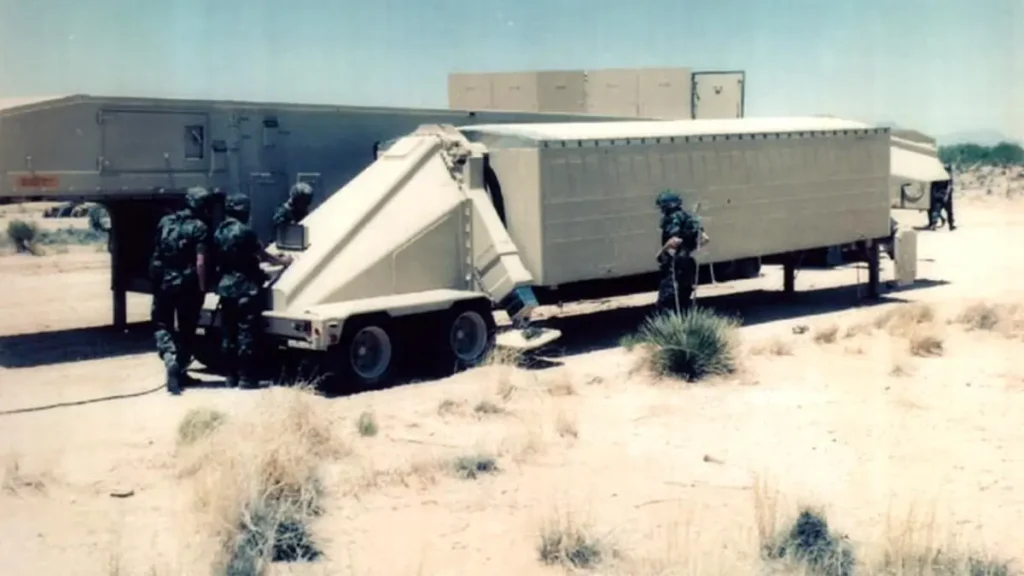
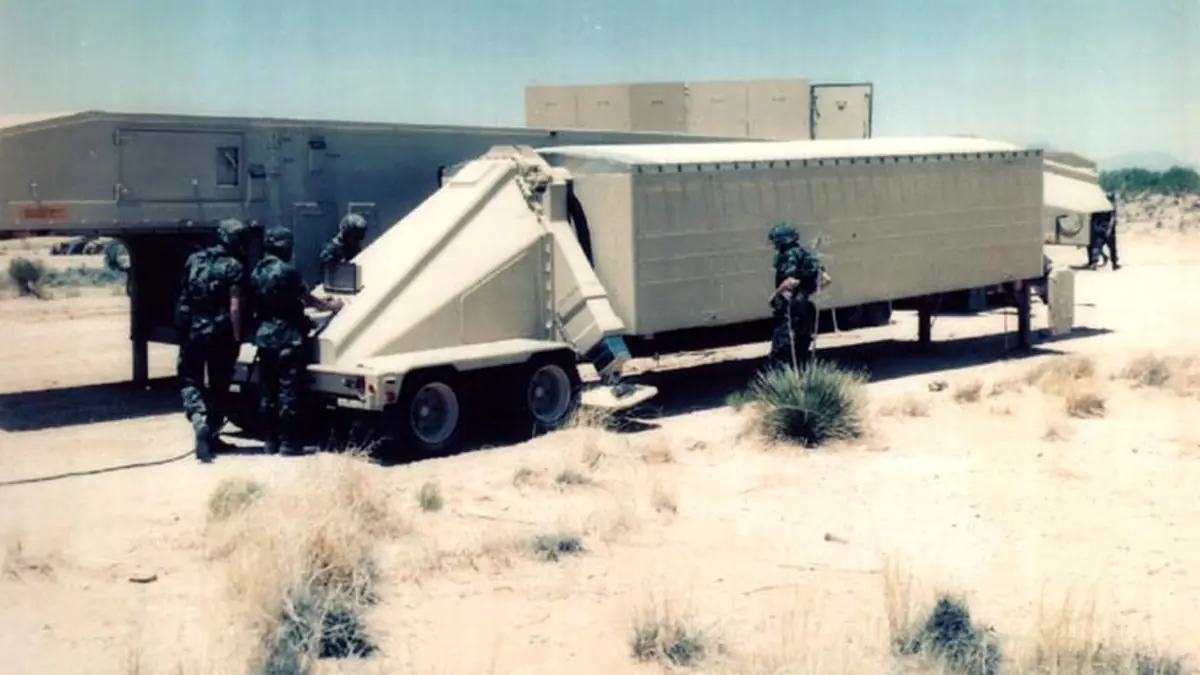
The AN/TPY-2 at NSA Bahrain is not merely a local air-defense asset. Deployed in 2019 and upgraded in 2023, it operates in forward-based mode — scanning thousands of kilometers into Iranian territory to acquire missile threats in their boost and midcourse phases. Its X-band beam provides the high-resolution tracking data that THAAD fire-control systems in the UAE and Qatar need to calculate intercept solutions for Iranian MRBMs and IRBMs. Critically, that same track data feeds via secure link into Israel’s Arrow-3 battery fire-control picture, giving Israeli interceptors the midcourse handoff they need for exo-atmospheric engagements. IISS Military Balance 2026 confirms no other forward-based X-band sensor in the region covers this geometry. The CSIS Missile Defense Project has documented that the Bahrain AN/TPY-2’s coverage arc spans the Iranian missile belt from Tabriz to Kerman — the same corridors from which Iran launched its October 2026 strikes on Israel.
True Promise III: Doctrinal Shift
Iran’s “True Promise” campaign began in April 2024 with its first direct missile barrage on Israel. “True Promise II” in October 2026 expanded to U.S. bases in Syria and Iraq. “True Promise III” marks a threshold crossing: the first kinetic attempt to blind a specific U.S. homeland-defense radar node on Arab soil. Tasnim and Fars translations of IRGC-ASF doctrinal publications have telegraphed this shift — “radar blinding” (körleme) tactics now appear as opening-move doctrine for any Israel-Iran conflict. By targeting the AN/TPY-2, Iran signals it understands the architecture: degrade the sensor, and you degrade the shooter across three nations simultaneously. This follows Iran-backed operatives indicted in the U.S. for a plot against RAF Fairford and tanker attacks in the Strait of Hormuz earlier this year.
Bahrain’s Impossible Calculus
Bahrain hosts the 5th Fleet and ~9,000 U.S. personnel because its geography commands the Strait of Hormuz and the Gulf’s maritime chokepoints. The AN/TPY-2 deployment was a sovereign decision by the Al Khalifa government, driven by shared threat perception of Iranian missile proliferation. But the November 15 attack exposes the asymmetry: Bahrain absorbs the kinetic risk — civilian sirens, shelter-in-place orders, intercept debris over Muharraq — while the radar’s strategic value accrues primarily to the U.S., UAE, Qatar, and Israel. Bahrain’s parliament has not debated the U.S. defense cooperation agreement renewal since 2023; domestic pressure to reconsider hosting a target that makes the island a primary Iranian aim point will now intensify. The kingdom’s calculus — security guarantee versus sovereign exposure — has no clean answer while the radar remains a single node.
The Gap Until 2028
CENTCOM’s answer to the single-node problem is the Low-Cost Multi-Mission Sensor (LCMC) program — a distributed sensor architecture to replace fixed-site X-band dependence with a mesh of cheaper, survivable nodes. Milestone B is slated for early 2027; IOC remains 2028. The FY27 NDAA will likely face scrutiny over a $400M-plus Bahrain radar hardening request that buys survivability for an architecture already slated for obsolescence. Program offices now face a compressed timeline: harden Bahrain (18 months, $400M+), accelerate LCMC (schedule risk), or accept a coverage gap Iran can exploit during any Israel-Iran exchange. The 2027 sensor-modernization RFP must now include Bahrain-survivability as a mandatory Key Performance Parameter, not a trade-space item. Senate Armed Services Committee hearings in early 2027 will test this mandate.
The AN/TPY-2 at NSA Bahrain is the only forward-based X-band sensor providing midcourse tracking data to both THAAD batteries in UAE and Qatar and Israel’s Arrow-3 exo-atmospheric interceptors. Iran’s November 15 salvo was the first kinetic attempt to blind this specific node — a strategic target whose loss would degrade missile warning for three U.S. allies simultaneously. No public reporting has connected this single radar to the triad of THAAD-UAE, THAAD-Qatar, and Arrow-3-Israel.
What happens if the Bahrain radar is destroyed — does Israel lose missile warning?
Yes. The AN/TPY-2 at NSA Bahrain is the sole forward-based X-band sensor providing midcourse track data to both Gulf-deployed THAAD batteries (UAE, Qatar) and Israel’s Arrow-3 exo-atmospheric interceptors. No other sensor in theater covers the same engagement geometry. Loss of this radar would create a blind spot for Iranian MRBM/IRBM trajectories headed toward Israel and the Gulf simultaneously. CENTCOM’s 2026 posture statement acknowledges “single-node risk” and funds a distributed-sensor follow-on (LCMC) with 2028 IOC — but until then, the Bahrain AN/TPY-2 is a strategic single point of failure.
Iran’s November 15 attack confirmed what defense planners have long modeled: the AN/TPY-2 radar at NSA Bahrain is the linchpin of a three-nation missile-defense architecture with no operational backup. CENTCOM intercepted the salvo, but the strategic signal is unambiguous — Iran knows the node, knows its value, and has crossed the threshold to kinetic targeting. The 2028 LCMC distributed-sensor architecture cannot arrive fast enough. Until it does, the radar in Bahrain remains the single most valuable target in the Gulf, and the 9,000 U.S. personnel, the 5th Fleet, and Bahrain’s 1.5 million civilians live in its engagement zone.