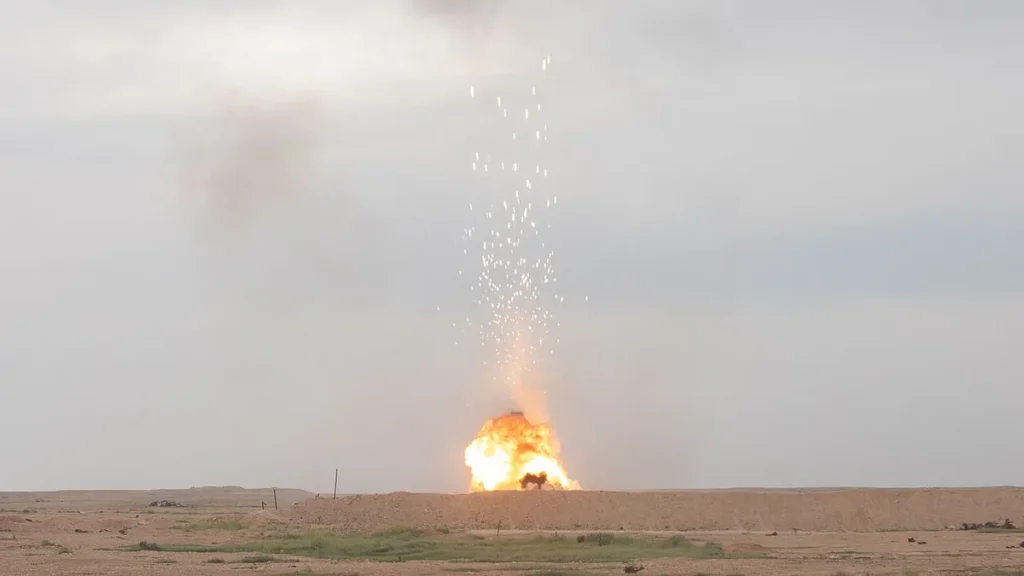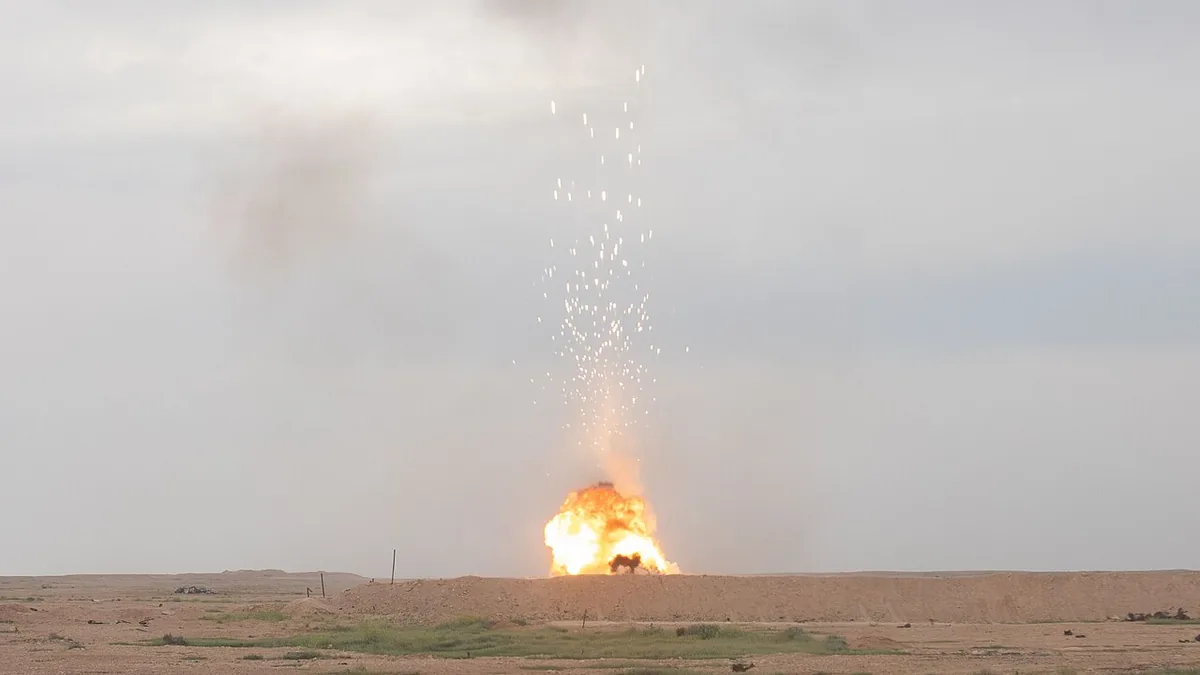
The US Army plans to detonate about five tonnes (roughly 9,500 pounds or 4.4 metric tons) of degraded lead azide at the Iowa Army Ammunition Plant in Middletown, Iowa, pushing ahead despite a federal court order that temporarily halted the operation. The facility borders Middletown, a rural community of roughly 360 residents located four hours west of Chicago, where federal officials argue that deteriorating explosives present an urgent safety hazard.
The volatile material is stored across 68 drums, but internal stability has broken down. An April inspection revealed crystallization in 58 of the 68 drums, signaling dangerous chemical degradation. Military officials warn that the compound has become acutely shock-sensitive and could detonate spontaneously if not destroyed under controlled conditions.
For residents living near the Middletown installation and downwind communities across the region, the planned blast carries a direct risk. Families in the immediate area were instructed to leave their homes for about six hours between 08:00 and 14:00 local time, while all humans were told to avoid outdoor activities. A controlled blast could send a lead dust plume over southeastern Iowa and into Illinois. Medical consensus warns that there is no safe level of lead exposure, leaving families weighing evacuation against toxic fallout.
The detonation was originally set for noon local time on Friday 20 November under an emergency permit granted by the Environmental Protection Agency, which found the explosion risk presented an imminent and substantial threat to human health and the environment. Acting Secretary of the Army Adam Telle delayed the blast to Monday 23 November, stating public safety was the Army’s top priority and that the delay would avoid a forecast temperature drop. On Thursday 19 November, the Iowa Environmental Council and the Sierra Club sued to challenge the EPA permit, prompting a federal court to order a pause and temporarily suspend the permit.
In a Saturday 22 November filing to the US Court of Appeals for the Eighth Circuit, the justice department notified the court that the Army intends to invoke a separate emergency exemption under federal hazardous waste regulations and carry out the controlled detonation by Tuesday 24 November. The Justice Department argued there is an “immediate risk” the lead azide will explode on its own as temperatures fall below 30F (-1C), noting the Army had removed the doors of the bunker storing the barrels, leaving the material more vulnerable to temperature changes. Government filings stated that “protection of human health and the environment demand action now, not delay” and that “to protect its personnel and the surrounding communities, the Army needs to take swift action,” maintaining that “a controlled detonation is by far safer than an uncontrolled explosion.” Planned safety measures include detonating inside earth-covered concrete magazines, surrounding them with sand barriers, and saturating the soil above with water.
Plume Modelling, Chemical Decay, and a Cancelled Cleanup Contract
Lead azide is a highly volatile compound used by the military as a detonator. For more than 20 years, the Middletown stockpile sat submerged in a bath of ethanol and water inside earthen-covered concrete magazines. However, a routine check found some of the water had evaporated, triggering the dangerous crystallization.
Controlled detonation was not the military’s initial remediation plan. The Army had previously hired an outside company to chemically neutralise the lead azide. That contract was cancelled two months later, with the Army citing “unacceptable risk to human safety” after concluding the process would have required seven to 22 days of handling.
Environmental advocates counter that explosive disposal turns an on-site hazard into a widespread environmental crisis. Army computer modelling showed a plume of lead could blow more than 100 miles into western Illinois depending on weather. In response, the Illinois Environmental Protection Agency asked for updated plume modelling, but the Army had not published updated maps for the new date by Sunday afternoon.
The lack of updated data has fueled anger among health advocates monitoring the risks of toxic exposure. The Iowa Environmental Council warned: “There is no safe level of lead exposure, and Iowans were given just days to prepare for the November 20 detonation.” On Sunday, the council and the Sierra Club filed a new motion asking the court to pause proceedings.
As temperatures drop toward freezing and the Eighth Circuit reviews the filings, Middletown residents remain in limbo. The stand-off now hinges on whether federal judges intervene once more or allow the military to detonate five tonnes of lead azide across the Iowa landscape.