Rebecca Ferguson as Captain Olivia Walker in A House of Dynamite, overseeing the White House Situation Room during an 18-minute nuclear crisis window.

Rahul Somvanshi

A House of Dynamite: Bigelow’s 18-minute nuclear crisis splits across three government perspectives

Directors, Entertainment, Movie, netflix, Nuclear

A House of Dynamite Interactive Analysis

Kathryn Bigelow returns to feature filmmaking eight years after Detroit with A House of Dynamite, a nuclear crisis thriller that premiered at the 82nd Venice International Film Festival on September 2, 2025, where it received an 11-minute standing ovation. The film, which began streaming globally on Netflix on October 24, 2025 after a limited theatrical release, examines 18 minutes of government response when an unattributed ICBM launches toward Chicago. Written by Noah Oppenheim, the screenplay structures the same timeframe across three chapters, each showing the crisis from different command centers—Fort Greely’s 59th Missile Defense Battalion, the White House Situation Room, United States Strategic Command, and the Presidential Emergency Operations Center.

Anatomy of a Nuclear Crisis

How Bigelow’s film dissects 18 minutes of decision-making across three government perspectives when an intercontinental ballistic missile of unknown origin targets the continental United States

Jake Baerington, the deputy national security advisor, runs through Washington D.C. streets amid the unfolding nuclear alert in A House of Dynamite
Deputy National Security Advisor Jake Baerington races toward the White House as communications collapse—a scene that captures how seconds, not policies, decide the pace of leadership in A House of Dynamite.

The film opens with text stating that the post-Cold War consensus on nuclear de-escalation “is now over.” Major Daniel Gonzalez (Anthony Ramos) at Fort Greely, Alaska detects what initially appears to be a test launch. When radar analysis confirms the missile’s inclination flattening—indicating a suborbital trajectory toward the continental United States—the Strategic Command apparatus mobilizes. Captain Olivia Walker (Rebecca Ferguson) coordinates response protocols from the White House Situation Room as DEFCON levels escalate from 4 to 2. The 59th Battalion launches two Ground-Based Interceptors; the first fails to deploy properly, the second’s Exoatmospheric Kill Vehicle misses its target. With Chicago confirmed as the impact point and 18 minutes on the clock, attribution becomes the central crisis.

Three Chapters, One Timeline

Bigelow structures A House of Dynamite as a triptych—the same 18-minute crisis viewed through escalating command levels. Each chapter ends on the same cliffhanger, building a complete picture of how fragmented intelligence and protocol limitations shape nuclear decision-making.

1
Inclination is Flattening
Detection & Initial Response
Fort Greely’s 59th Missile Defense Battalion detects the ICBM. Major Gonzalez authorizes weapons-release authority for GBI launch. Captain Walker in the White House Situation Room coordinates with Admiral Mark Miller as the threat assessment confirms Chicago as target with 19 minutes to impact. DEFCON 2 status confirmed.
Rebecca Ferguson Anthony Ramos Jason Clarke
2
Hitting a Bullet with a Bullet
Strategic Analysis & Attribution Crisis
General Anthony Brady at STRATCOM debates counterstrikes while Deputy NSA Jake Baerington reveals GBI success rates hover at 61%—”hitting a bullet with a bullet.” North Korea expert Ana Park joins via video conference from a Civil War reenactment. Attribution remains uncertain as both interceptors fail.
Tracy Letts Greta Lee Gabriel Basso
3
A House Filled with Dynamite
Executive Decision & Retaliation Debate
The President (Idris Elba), initially at a youth basketball event, boards Marine One for emergency transport. Secretary of Defense Reid Baker—whose daughter lives in Chicago—faces personal crisis alongside professional duty. Nuclear response “menu” options presented. Final decision remains unshown as film cuts to aftermath sequences.
Idris Elba Jared Harris
U.S. president character on Marine One reviewing nuclear response options during the crisis in A House of Dynamite
The U.S. president weighs a laminated “menu” of nuclear responses aboard Marine One—policy reduced to probabilities as the 18-minute window narrows and attribution remains unresolved.

The 18-Minute Window

From initial detection to potential impact in Chicago, the film compresses decision-making into real-time urgency. Start the simulation to visualize how rapidly the crisis unfolds.

18:00
Until Chicago Impact
Detection to Potential Detonation
0:00
ICBM Launch Detected
4:30
DEFCON 2 Status
9:00
GBI Launch Sequence
13:30
Interceptor Failure
18:00
Impact Window
Command-center countdown and interceptor tracking as Anthony Ramos's Major Daniel Gonzalez's team races the clock in A House of Dynamite
Countdown screens tighten as Anthony Ramos (Maj. Daniel Gonzalez) and interceptor crews face the limits of hardware, software, and time—how should leaders act when attribution is still in doubt?

Critical Moments in the Crisis

Five pivotal sequences define the narrative’s escalating tension, each raising questions about protocol, technology, and human judgment under pressure.
Minutes 1-3
Initial Detection & Verification
Fort Greely tracks unidentified object. Rate of ascent slows, inclination flattens. Current velocity indicates suborbital trajectory. Multiple radar systems confirm: 19 minutes to impact somewhere in continental United States.
Minutes 4-7
Weapons Release Authorization
Major Gonzalez authorizes GBI launch. STRATCOM convenes video conference with Secretary Baker. Deputy NSA Baerington joins via FaceTime while running toward White House. Chicago identified as probable target.
Minutes 8-11
Attribution Intelligence Gap
Launch site remains unidentified. North Korea expert Ana Park pulled from Battle of Gettysburg reenactment. General Brady advocates for preemptive counterstrikes. NSA argues for communication and restraint.
Minutes 12-15
Ground-Based Interceptor Failure
First GBI fails to detach, falls to earth. Second GBI reaches missile but kill vehicle misses connection. Success rate revealed: barely over 50%. Secretary Baker: “So it’s a fucking coin toss?” FEMA begins evacuations.
Minutes 16-18
Presidential Nuclear Decision
President aboard Marine One reviews laminated response options. Lt. Cmdr. Reeves presents nuclear football. Baker’s daughter confirmed in Chicago. Film ends without showing final decision as officials enter Raven Rock Mountain Complex.
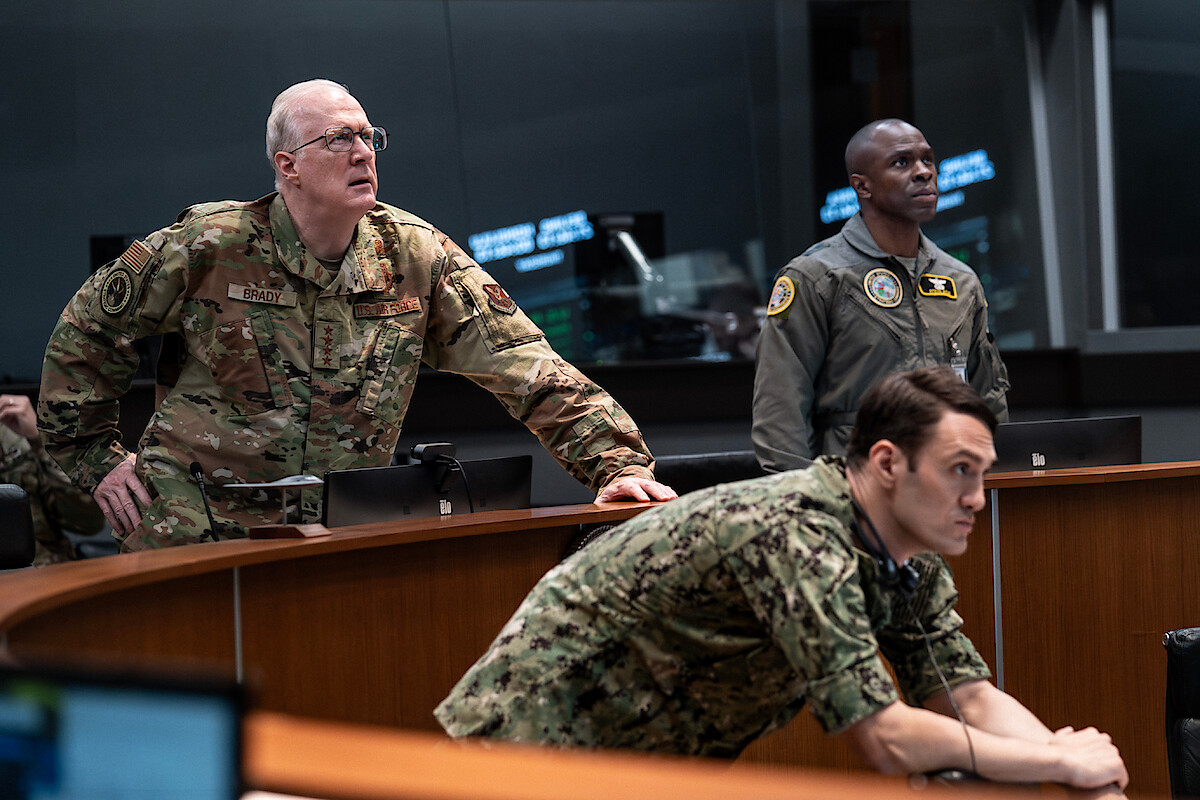
Tracy Letts as General Anthony Brady reviewing missile-defense options at U.S. Strategic Command in A House of Dynamite
At STRATCOM, Tracy Letts (Gen. Anthony Brady) weighs “hitting a bullet with a bullet,” where test-range percentages meet real-world consequences—should math alone steer the next move?

The Nuclear Response Framework

The President confronts four response categories with incomplete attribution data. Select each option to examine the strategic considerations Bigelow presents through dialogue and tension.

SITUATION: Unattributed ICBM confirmed inbound to Chicago. Both GBI attempts failed. Launch origin uncertain—possibilities include North Korea, Russia, China, non-state actor, or submarine captain acting independently. 18 minutes elapsed. What response authorizes the President?

Await Attribution
& Impact Assessment
Limited Conventional
Strike on Suspects
Proportional Nuclear
Response
Comprehensive
Retaliation

!

The 50% Problem

Deputy National Security Advisor Jake Baerington reveals mid-crisis that Ground-Based Interceptor success rates in testing hover at 61%—”hitting a bullet with a bullet.” The Pentagon’s Missile Defense Agency, according to Bloomberg reporting, expressed displeasure with this depiction of a system costing over $50 billion. Secretary Baker’s response in the film—”So it’s a fucking coin toss?”—captures both the technical reality and emotional weight of missile defense limitations when minutes matter.
Jared Harris as Secretary of Defense Reid Baker coordinating with national-security analysts in A House of Dynamite
Jared Harris (SecDef Reid Baker) and analysts—including Greta Lee (Ana Park)—work the lines as attribution stays uncertain, a reminder that fractured signals can shape policy as much as doctrine.

Cinematographer Barry Ackroyd shot the ensemble cast across multiple sets simultaneously—White House Situation Room, STRATCOM operations center, Fort Greely command post—with actors performing on live video feeds to maintain authenticity. Production designer Jeremy Hindle built fully functional command environments where performers remained attentive for weeks as cameras captured real-time conference calls. Editor Kirk Baxter structured the three-chapter format to build cumulative tension despite narrative repetition, a technique that Euronews Culture noted creates initial “nerve-shredding” impact before yielding “diminishing returns” in subsequent chapters.

The Decision-Making Ensemble

Bigelow assembled performers across government hierarchy levels—from battalion commanders to situation room officers to cabinet members to POTUS—creating what screenwriter Noah Oppenheim describes as a portrait of people called to make “impossible decisions in the most extreme circumstances imaginable.”

Idris Elba
President of the United States
Rebecca Ferguson
Captain Olivia Walker
Jared Harris
Secretary of Defense Reid Baker
Tracy Letts
General Anthony Brady
Anthony Ramos
Major Daniel Gonzalez
Gabriel Basso
Deputy NSA Jake Baerington
Greta Lee
NSA North Korea Expert Ana Park
Jason Clarke
Admiral Mark Miller
Moses Ingram
FEMA Official Cathy Rogers
Jonah Hauer-King
Lt. Cmdr. Robert Reeves
Kaitlyn Dever
Caroline Baker
Kyle Allen
Captain Jon Zimmer
Idris Elba as the U.S. president on Marine One reviewing nuclear response options in A House of Dynamite
Air-crew members aboard a stealth B-2 bomber monitor incoming data as the crisis unfolds—an image that underscores how precision, restraint, and timing can decide the outcome in A House of Dynamite.
i

Reception & Context

A House of Dynamite premiered in competition at the Venice Film Festival on September 2, 2025, where it received an 11-minute standing ovation. NPR’s review praised the film as “unnerving” and noted that “Bigelow is unsurpassed at action and suspense.” The film represents Bigelow’s first feature since Detroit (2017) and reunites her with cinematographer Barry Ackroyd, who shot The Hurt Locker. Composer Volker Bertelmann, who scored All Quiet on the Western Front, provided the soundtrack.

A House of Dynamite structures its examination of nuclear crisis response across 108 minutes, with each of three chapters covering the same 18-minute window from escalating command perspectives. The film’s premise—an unattributed ICBM targeting Chicago with failed interceptor attempts—places attribution uncertainty at the center of retaliation debates. Bigelow’s production approach involved simultaneous filming across multiple command-center sets with live video connections between performers, maintaining technical authenticity for conference-call sequences that define modern crisis coordination. The ensemble cast, led by Elba, Ferguson, Harris, and Letts, portrays government officials confronting protocol limitations when decision timeframes compress and intelligence remains incomplete. Critical reception acknowledged the film’s initial tension while noting structural challenges in sustaining momentum across repeated timelines. The work joined Netflix’s fall 2025 slate after limited theatrical distribution and festival screening at Venice.


Leave a Comment