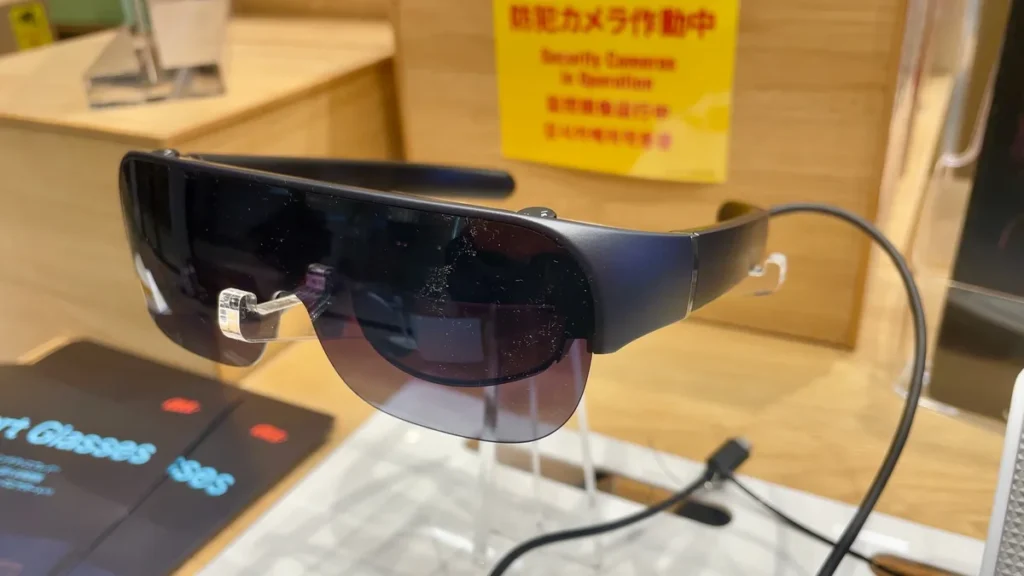
You’ve seen the videos: someone wearing Meta’s Ray-Ban smart glasses walks into a coffee shop, glances at a stranger, and a whispered prompt pulls up that person’s LinkedIn profile, their address, their phone number. The glasses don’t blink. The stranger doesn’t know. Harvard students proved it works. Meta calls it a feature. Privacy advocates call it a surveillance tool. Google’s answer arrives this week: Android XR smart glasses that blur every face before the image ever leaves the frame, ban third-party facial recognition entirely, and lock the recording light so it cannot be covered. The “perv glasses” era just met its structural opponent.
What Google’s Android XR Glasses Actually Do
Google’s Android XR smart glasses, built by Samsung in partnership with Warby Parker and Gentle Monster, automate a privacy pipeline that Meta’s Ray-Bans leave optional. When a wearer activates Gemini — asking for a translation, identifying an object, or getting context on their surroundings — the glasses capture the camera view. Before that image leaves the device, an on-device model detects faces and applies a blur. The redacted frame is what travels to Google’s servers for Gemini processing. The original, unblurred image never leaves the glasses.
The same protection applies to the wearer. Point the glasses at a mirror, or catch your own reflection in a window, and your face is blurred before the query is processed. Google says images and videos submitted for Gemini requests are not saved in the user’s Gemini history log. They are not used to train AI models, not used for ad personalization, and not used for targeted advertising.
Preorders opened November 13 at $395. Shipments to the United States and South Korea begin December 10, 2026. The glasses feature a 12-megapixel ultrawide camera, built-in speakers and microphone, up to nine hours of battery life, and compatibility with Pixel, Galaxy (Android 17/One UI 9), and iPhones. The launch coincides with Google’s Gemini 4 Hydrogen release, which promises 2.5x speed gains and a 1 million token context window.
What This Means for You
If you buy these glasses, your bystanders are protected by default. If you develop for them, you lose facial recognition and live streaming — the two features that make smart glasses feel like spy gear. If you wear Meta’s Ray-Bans today, you are the only one deciding whether to record a face. With Android XR, the firmware decides for you. That shift moves privacy from a user choice to a system guarantee. It’s a contrast to Netflix’s AI Discover feature, which uses viewing history for recommendations without similar hardware-level privacy guards.
How the Face Blur Actually Works
The face blur happens at the firmware level, before any application — including Google’s own — sees the frame. It is not a setting the user can toggle. When Gemini is invoked, the on-device vision model scans the frame, detects faces, and applies a Gaussian blur. The processed frame is encrypted in transit to Google’s Gemini inference endpoints. Google says the unblurred frame is discarded from memory immediately after redaction.
This systemic design choice also covers the wearer. Catch your own reflection while checking a notification, and your face is blurred before the query processes. Google says images and videos submitted for Gemini requests are not saved in the user’s Gemini history log. They are not used to train AI models, not used for ad personalization, and not used for targeted advertising.
Third-Party Apps Lose Facial Recognition and Live Streaming
The privacy architecture extends to the Play Store. Apps built for Android XR glasses are prohibited from accessing the cameras for real-time facial recognition or live streaming. Only native system apps — the camera, the Gemini interface, the translation tool — can use the camera feed, and they all inherit the face-blur pipeline.
Developers also cannot disable or tamper with the front-facing privacy LED. The indicator lights up whenever the glasses are recording. Google built anti-tampering protections into the hardware: if a user covers the LED or disables it in software, the camera simply will not record. Each pair of glasses also includes a physical kill switch that cuts power to the camera and microphone instantly.
A Harvard student demonstrated last year that Meta’s Ray-Ban smart glasses could be modified into a real-time facial recognition device. That proof-of-concept — secret filming plus instant identity lookup — is exactly what Google’s architecture tries to make impossible on Android XR.
Hardware Specs: Samsung Build, Warby Parker Design
The first wave of Android XR glasses carries Samsung branding with frame designs from Warby Parker and Gentle Monster. They feature a 12-megapixel ultrawide camera, built-in speakers and microphone, and a battery rated for up to nine hours of mixed use. The charging case provides multiple top-ups.
Compatibility requires a Google Pixel or Samsung Galaxy device running Android 17 (or One UI 9 on Samsung). iPhones are also supported, though with reduced feature parity. Preorders opened November 13 at $395. Shipments to the United States and South Korea begin December 10, 2026. The Samsung partnership mirrors the ecosystem play seen in GTA 6’s record-breaking preorder strategy, where platform exclusivity drives hardware adoption.
Gemini Integration: The Privacy Trade-Off
The glasses exist to put Gemini in your field of view. That utility — translate a menu, identify a plant, summarize a document — requires sending camera data to the cloud. Google’s bet is that users will accept the trade-off if the privacy guardrails are visible, enforced, and non-negotiable.
The company has not claimed the system is 100 percent foolproof. Edge cases — unusual angles, partial occlusions, rapid motion — could theoretically let a face slip through the blur. But the architecture makes it a firmware bug, not a policy choice.
For developers, the message is clear: the camera is a sensor for system intelligence, not a feed for app innovation. No facial recognition APIs. No live-streaming hooks. No workaround for the LED.
What This Means for the Smart Glasses Category
Meta’s Ray-Ban glasses, often called “perv glasses” by critics, ship with no face blur, no on-device redaction, and no hardware LED tamper protection. They rely on user discipline and social norms. Android XR makes privacy a default that cannot be toggled off.
If the market adopts Google’s approach, the next generation of smart glasses — from Apple, from Meta, from any Android XR licensee — will face pressure to match the baseline. The Harvard student’s Meta hack proved the risk is real. Google’s response proves a systemic fix is possible. The stakes echo Alphabet’s AI capex ROI challenge, where a $500 billion stock drop forced a reckoning on whether AI investments serve users or advertisers.
Preorders are live. The first units ship December 10. The real test starts when thousands of people wear them in public.
Can Android XR glasses do facial recognition? No. Third-party apps are banned from using the cameras for real-time facial recognition. Only native system apps can access the camera feed, and all frames are blurred before leaving the device for Gemini processing.
Google’s Android XR glasses arrive with a privacy architecture that Meta’s Ray-Bans lack: mandatory face blur, banned facial recognition apps, tamper-proof recording indicators, and a physical kill switch. At $395, they offer the first consumer smart glasses where privacy is not optional — it is baked into the firmware. Whether that wins buyers or just sets a standard others must follow will be clear by the December 10 ship date.