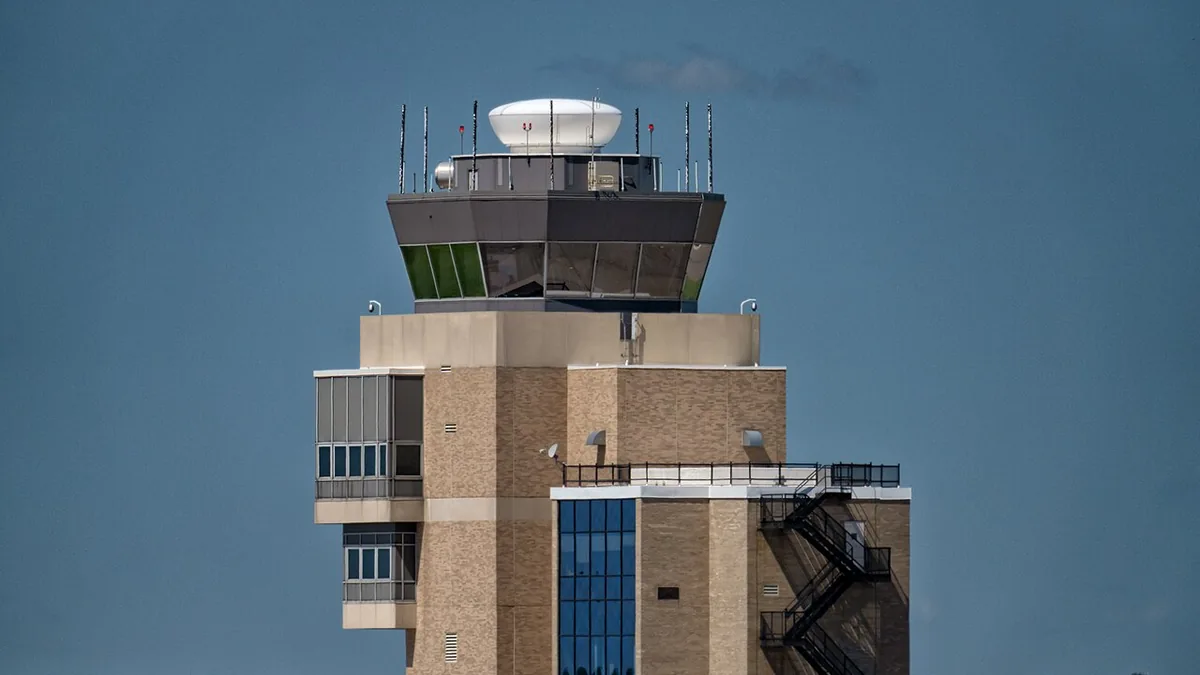
The Federal Aviation Administration ordered a rare nationwide ground stop at every U.S. airport on Friday afternoon, halting all departing flights after a communication failure hit multiple air traffic control centers.
The advisory told operators that “all departing traffic should remain ground stopped until further notice.” Inbound international flights would be “managed on a case by case basis,” the FAA said.
For travelers, the order means new domestic departures are suspended, and flights already in the air may land wherever they can. Thousands of flights were delayed or canceled within hours, and the disruption could continue into the weekend.
What caused the ground stop
The FAA said the stop followed “communication issues impacting multiple Air Route Traffic Control Centers.” Transportation Secretary Sean Duffy, who was nominated in 2024 to oversee aviation safety and infrastructure modernization, said the cause was “a communication issue impacting all Air Route Traffic Control Centers,” and that FAA technicians were investigating.
Air Route Traffic Control Centers, often called “centers,” mostly handle high-altitude en route airspace between airports. An internal Alaska Airlines message described the problem as communications and radar issues, CNBC reported.
Operators were told “by order of the Federal Aviation Command Center” that airports were ground stopped. Shortly before the national order, both major airports in Chicago, O’Hare International and Midway International, were listed under a ground stop because of an “equipment outage.”
The FAA has been rolling out a new AI tool designed to help manage airspace congestion. It is not clear whether that system has any connection to Friday’s communication issues.
Homeland Security Secretary Markwayne Mullin said at the White House on Friday evening that there was no indication of a “nefarious attack.”
How many flights were affected
More than 7,800 flights were delayed or canceled as of 4:45 p.m. ET, according to Fox Weather. At the time of the order, roughly 3,000 flights were in the air. Chicago’s aviation department reported 213 delays at O’Hare and 55 at Midway as of 3:11 p.m.
At Newark Liberty International Airport, personnel in the control tower described the situation as “a whole mess right now,” according to LiveATC. “We’re running out of space” was among the comments heard on the live audio feed. “I’m as much in the dark as everyone else, I’m not getting any information from anybody,” one controller at Newark said.
United Airlines, which is headquartered in Chicago, said “flights that are already airborne will continue” and that “new domestic flights will not depart while the FAA ground stop remains in place.”
Deveren Werne was on an American Airlines jet preparing to take off from Indianapolis for Chicago when the pilots announced that all flights were grounded. “At first the pilot announced that there was some kind of radio issue,” Werne, 55, told NBC News. “Then a little while later, the pilot said something like, ‘There is something going on that’s more serious than that.'”
How rare a nationwide ground stop is
Nationwide ground stops are extremely rare. After the Sept. 11, 2001, terrorist attacks, the FAA halted all civilian air traffic across U.S. airspace and ordered airborne planes to land at the nearest available airports. In January 2023, the FAA grounded all flights again, blaming a failure in the Notice to Air Missions system, which alerts pilots to a host of potential dangers. That stop lasted about an hour and a half.
A ground stop halts flights at their departure point. Disruptions tend to snowball if a stop drags on, because flight crews reach their maximum duty hours for the day.
The stop is the most serious disruption to U.S. air travel in years. It comes a fortnight after the McMinnville helicopter collision exposed weaknesses in airspace safety protocols, and it is the latest in a run of technology failures that have disrupted daily life, including the Microsoft Outlook outage that hit email and Teams for millions of people this week.
What happens next
The FAA said technicians were investigating and that updates would follow. The Axios report noted that airports could quickly run out of gates and room for the thousands of flights navigating the crisis while already airborne.
The stop also prevented NTSB investigators from reaching the scene of Friday’s collision between a Mississippi River cruise ship and a tanker in New Orleans, Rep. Troy Carter told a local station.
The ground stop also raises a question for Friday’s other major aviation event. The FAA granted a launch license for SpaceX’s Starship Flight 15, scheduled to lift off from Texas at 5:45 p.m. ET. Space.com reported that it is unclear whether the ground stop will affect the launch or the rocket’s planned return.
Travelers should check with their airlines before heading to the airport. Check back for updates.