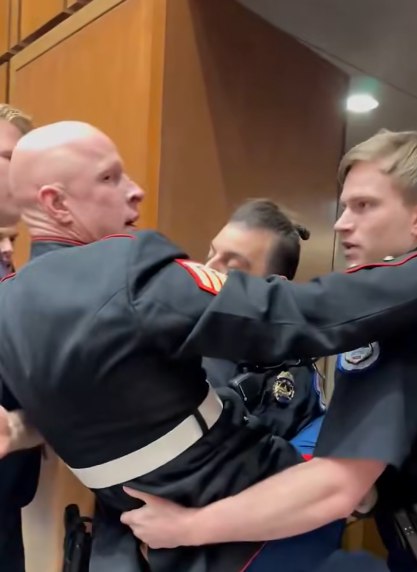
A Senate Armed Services subcommittee hearing on Marine Corps readiness turned chaotic on March 4, 2026, when Brian C. McGinnis — a 44-year-old Marine Corps veteran, professional firefighter, and Green Party Senate candidate from North Carolina — stood up in the audience section of the Hart Senate Office Building and shouted statements opposing U.S. military action in Iran.
Three U.S. Capitol Police officers moved to remove him. Sen. Tim Sheehy (R-MT), a former Navy SEAL seated at the dais as a panel member of the Senate Armed Services subcommittee, left his seat and joined the officers. The struggle ended at the hearing room doorway — with McGinnis’ arm lodged in the door frame, three officers injured, and seven criminal charges filed. This article covers the verified factual record, from the exact charges to the statements made by those directly involved.
Minute by Minute: What Happened on March 4
Tap any card to expand the verified details of each stage of the incident.

Who Is Brian McGinnis — and Who Is Sen. Tim Sheehy?
Both men have a military background. Their paths crossed on March 4, 2026, in a Senate hearing room.
Why This Hearing, Why This Day
In the days before March 4, McGinnis had posted multiple videos criticising U.S. and Israeli military strikes against Iran. His campaign platform is strictly anti-war and he has pledged to reject corporate donations. The hearing itself was focused on Marine Corps readiness and force design — not foreign policy — but the protest reflected how the Iran conflict had permeated every corner of Washington’s legislative calendar.
President Donald Trump had stated publicly that the conflict — which spread to multiple countries around the Persian Gulf — could last weeks. The U.S. Department of Defense confirmed operations targeting Iranian Revolutionary Guard facilities and naval assets. That same week, the U.S. Senate voted down a measure that sought to limit presidential authority to continue military operations against Iran without explicit Congressional approval, a debate directly linked to how citizens engage with wartime decisions.
Under Congressional rules enforced by Capitol Police, demonstrations inside Congressional buildings are prohibited. Designated protest areas exist outside on Capitol grounds. This is the legal basis for the seven charges McGinnis faces. For context on free speech and its limits in democratic societies, CruxBuzz has covered this question at length.

The 7 Charges Against Brian McGinnis
Tap any charge to read the details. Source: U.S. Capitol Police press statement, March 4, 2026.
Where It Happened — Hart Senate Office Building, Washington D.C.
The incident occurred inside the Hart Senate Office Building on Capitol Hill. Click the markers for details.
In Their Own Words
All quotes are from official press releases, direct social media posts, and statements — no third-party media sources.

Six Verified Facts That Frame the Full Story
Each card below covers a confirmed detail or background point drawn from primary sources.
More From CruxBuzz
Related reporting and analysis you should read alongside this story.
What the Record Shows
The arrest of Brian C. McGinnis at the Senate Armed Services subcommittee hearing on March 4, 2026 was covered in this article — including the full sequence of events, the seven charges filed by U.S. Capitol Police, the on-record statements from those directly involved, and the Congressional rules that formed the legal basis for the arrest.
McGinnis — a Marine Corps veteran, professional firefighter, and Green Party Senate candidate from North Carolina — was charged with three counts of assault on a police officer, three counts of resisting arrest, and one count of crowding, obstructing and incommoding during an unlawful demonstration. Sen. Sheehy left the dais to assist Capitol Police, and later posted a statement on X describing his actions. Three officers and McGinnis received medical treatment following the altercation.
The incident took place during active debate in Washington over U.S. military posture and the boundaries of political dissent in democratic institutions. All charges, statements, and rules cited were drawn from primary institutional sources: the Capitol Police, the D.C. Superior Court, the U.S. Department of Defense, and the Senator’s own public statement via X.