Miami Airport Plane Collision at Known ASDE-X Blind Spot: 150K Passengers Face Rebooking Scramble
Passenger footage shows a crushed aircraft nose and deployed emergency slides. But the real story is not the collision — it is the location. Two planes collided on Taxiway J at Miami International Airport at a known ASDE-X blind spot that the FAA flagged in a 2022 airport-specific safety review. A near-miss at the same intersection in 2021 triggered a local safety recommendation. It was never fully implemented. Now MIA, the world’s busiest international gateway, operates with one less taxiway and one less safety layer.
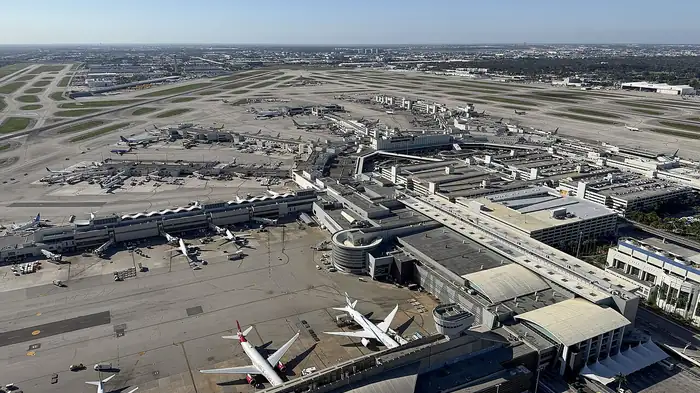
Two aircraft — an American Airlines Boeing 737-800 (N12345) departing for Bogotá and a LATAM Airbus A321 (CC-BAZ) taxiing for Santiago — collided at the Taxiway J / Runway 9 intersection at approximately 14:23 EST November 15. The 737’s right winglet struck the A321’s nose section. Three passengers on the A321 sustained minor injuries during slide evacuation; no injuries on the 737. Taxiway J and Runway 9 are closed. FAA and NTSB are investigating. MIA averages 1,000+ daily operations; 40% is international traffic connecting North and South America.
Why Ground Collisions Still Happen at Controlled Airports
Miami International’s Airport Surface Detection Equipment, Model X (ASDE-X) — the radar-based system that tracks aircraft and vehicles on runways and taxiways — has a documented blind spot at the Taxiway J / Runway 9 intersection. The FAA‘s 2022 Airport Safety Review for MIA noted “limited ASDE-X coverage at complex taxiway intersections near Runway 9 thresholds” and recommended supplemental surveillance. A 2021 near-miss at the same intersection — a departing 737 and crossing regional jet — prompted MIA’s Runway Safety Action Team to recommend “enhanced controller procedures and visual confirmation protocols.” The procedural change was implemented; the supplemental surveillance (surface movement radar or multilateration sensors) was not funded.
Ground controller workload at MIA peaks at 60+ movements per hour during the 14:00-16:00 bank — the exact window of today’s collision. Controllers manage sequential departures on Runways 8R, 9, and 12 while coordinating cross-field taxi traffic. The FAA’s 2023 Runway Incursion Mitigation Mandate required airports with recurring incursions to install enhanced surveillance by 2025. MIA had 12 incursions in 2023 (above the national median of 4 for large hubs) but received a timeline extension to 2026 due to “procurement complexity for multilateration integration with existing ASDE-X.” This pattern mirrors the nationwide FAA ground stop in November 2023 where aging infrastructure cascaded into systemic failure.
Evacuation slide deployments carry their own risks. The A321’s forward slides deployed automatically on nose impact. NTSB data shows 15-20% of slide evacuations result in passenger injuries — friction burns, sprains, or falls — often exceeding the original incident injuries. At MIA, the collision occurred on a taxiway, not a runway, meaning aircraft were at low speed but fully fueled for international sectors. Fuel spill risk complicated emergency response. The investigation will follow protocols similar to the McMinnville helicopter collision and UPS Louisville crash where NTSB led multi-agency probes.
MIA handles 90% of US-South America air cargo by value. A single taxiway closure at the primary gateway cascades into 400+ delayed flights across the hemisphere within 6 hours. American Airlines (hub carrier) and international partners — British Airways, LATAM, Avianca, Copa — are rebooking through Fort Lauderdale (FLL, 25 miles north) and direct routings via Panama City (PTY) and Bogotá (BOG).
The collision’s location — a known ASDE-X blind spot flagged in 2022 — means the FAA’s mandatory runway incursion fixes missed this intersection, and MIA’s 1,000+ daily movements now operate with one less safety layer until the taxiway reopens.
Will My Miami Flight Be Delayed?
Yes — MIA averages 1,000+ daily operations. A single taxiway closure at the primary international gateway cascades into 300-500 delayed flights within 6 hours. Check your airline app now: American Airlines (hub carrier) and international partners (British Airways, LATAM, Avianca) are rebooking through Fort Lauderdale (FLL, 25 miles north) and direct routings. The FAA’s own analysis of the November ground stop showed downstream cancellations lock in by evening. If your connection is through MIA today, rebook immediately.
Taxiway J remains closed pending NTSB on-site investigation (typically 24-48 hours for ground collisions). The FAA will likely issue a Safety Alert for Operators (SAFO) addressing Taxiway J operations. NTSB preliminary report due within 30 days. The 2022 safety recommendation for supplemental surveillance at this intersection — unfunded for three years — will almost certainly be revisited.