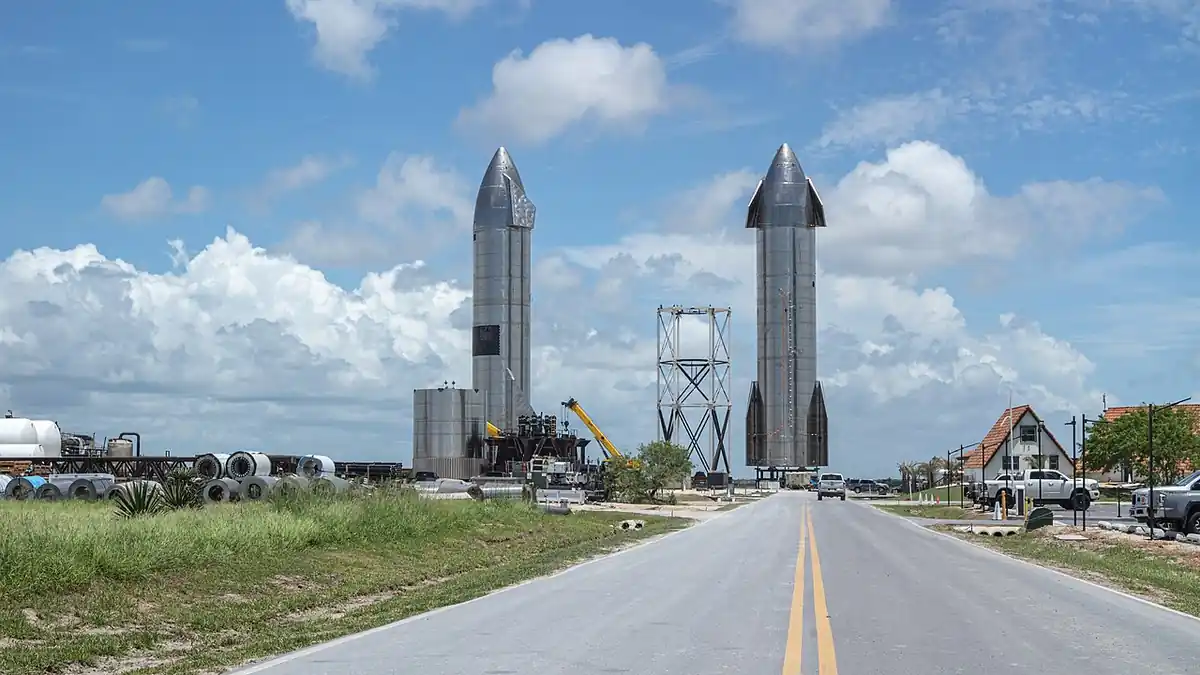
SpaceX is preparing to launch its Starship rocket on its 15th test flight on Friday, with a plan to do something no orbital rocket has ever done: bring both stages back to the launch pad and catch them in mid-air.
The 124-metre-tall rocket is scheduled to lift off from SpaceX’s Starbase site in South Texas during a 75-minute window that opens at 5:45 p.m. ET. If the mission succeeds, it will mark the first full recovery of an orbital launch system.
For readers, the flight is the biggest test yet of whether Starship can be reused like an airplane. Full reusability is the key to SpaceX’s plans for hourly launches, cheaper Starlink deployment, and eventually crewed missions to the moon and Mars.
What the double catch means
The mission will use Booster 22 and Ship 42. About 6.5 minutes after liftoff, the Super Heavy booster will return to Starbase, where a launch tower known as “mechazilla” will try to catch it with mechanical arms called “chopsticks.” It would be the first catch of a next-generation Super Heavy V3 vehicle.
The upper stage, Ship 42, will enter a low Earth orbit of about 275 km, circle Earth 14 times, and deploy 26 Starlink V3 satellites. Each satellite adds about 1 terabit of capacity, and the full batch equals roughly 10 separate Starlink V2 Mini launches on the smaller Falcon 9 rocket, SpaceX says. Three of the satellites carry cameras to inspect the ship’s heat shield in orbit and help controllers decide whether the vehicle is healthy enough to return.
About 22.5 hours after launch, Ship 42 will attempt the first Ship reentry over inhabited areas, flying over sparsely populated regions of northern Mexico and southern Texas. It will make a bellyflop maneuver as it descends to Pad 2, then flip vertical for the tower’s waiting arms. The debut Ship catch is scheduled for around 3:45 p.m. ET on Saturday.
SpaceX calls the double catch the “Holy Grail of rocketry.” In its Flight 15 mission description, the company wrote: “If successful, this will mark the first full recovery of an orbital launch system and a breakthrough moment in making Starship a reliable, rapidly reusable rocket.”
Elon Musk posted on X on Nov. 6: “If both are successful, it will mark the first time that all parts of an orbital rocket return to Earth intact. This is the critical breakthrough needed to make life multiplanetary.”
Why Starship matters
Starship is the largest and most powerful launch vehicle ever developed. SpaceX has caught three Super Heavy boosters and reused two of them, with the last tower catch in March 2025. Catching the upper stage is the harder half of the puzzle, because it returns from orbital speeds and must survive the heat of reentry.
Starship reached orbit for the first time on Flight 14 on Sept. 28, despite some engines shutting down mid-flight. That mission, planned to last 10 hours, ended after roughly three hours with an intact splashdown in the Pacific Ocean.
NASA has helped fund Starship’s development with roughly $3.2 billion since selecting the rocket in 2021 to serve as the moon lander for its Artemis program. SpaceX has put at least $15 billion of its own money into the vehicle. NASA and SpaceX expect Starship to land humans on the moon by 2028.
Starship is also central to SpaceX’s Starlink satellite internet business, and the company plans to phase out its workhorse Falcon 9 rocket in favour of Starship. SpaceX also wants to deploy an orbital data center constellation, and Musk has said he wants to launch 10,000 Starship missions per year by 2030, with a weekly launch cadence by the first half of 2027.
SpaceX’s space ambitions depend heavily on government work. During a 2025 feud with President Trump, the White House threatened to cancel $22 billion in space contracts. And the rocket’s long-term goal, crewed Mars missions, has been a focus of NASA and DARPA research for years.
Morgan Stanley analyst Adam Jonas called Flight 15 a major catalyst for SpaceX and said the flight gave investors a reason to revisit the company. Musk said last month that he expects the double catch to work. “I’d say it’s more likely than not that this succeeds next flight,” he said during SpaceX’s third-quarter earnings call.
How to follow the launch
The launch window opens at 5:45 p.m. ET and runs for 75 minutes. SpaceX will provide a live webcast of the entire mission, expected to last nearly a full day, on its website and on X. Coverage begins about 30 minutes before liftoff and continues until the upper stage potentially returns to the launch site.
SpaceX will only attempt the Ship catch if all systems on the vehicle look good. If there are problems, the company will divert to a splashdown in the Pacific Ocean, near either Hawaii or Chile. The schedule is dynamic and likely to change. Check back for updates.