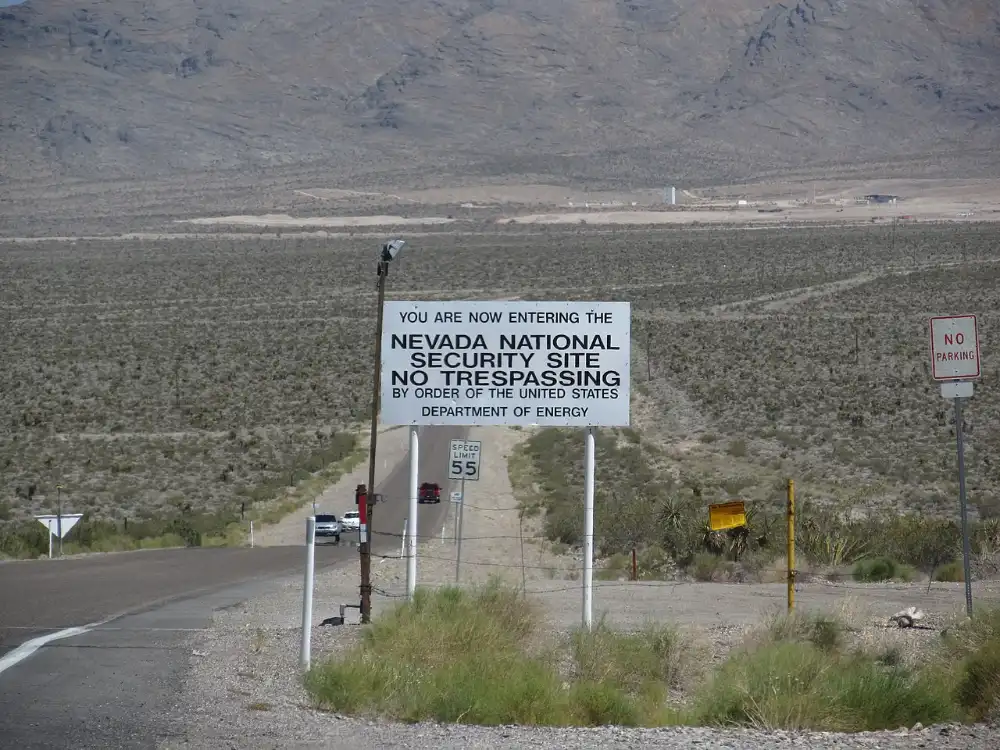
President Donald Trump announced on October 30, 2025, that the United States will resume testing nuclear weapons, marking a potential end to a 33-year moratorium that began in 1992. The announcement came just before his meeting with Chinese President Xi Jinping in Busan, South Korea, during talks aimed at restoring stability after months of trade and economic tensions.
Trump posted on social media that he had instructed the Department of Defense to begin testing nuclear weapons “on an equal basis” with other countries, specifically citing Russia’s recent nuclear-capable weapons demonstrations and China’s expanding arsenal as justification for the policy shift.
The decision comes at a time of heightened global nuclear tensions, with Russia continuing its war in Ukraine and China rapidly expanding its nuclear capabilities. The move also occurs just 100 days before the expiration of the New START treaty in February 2026, the last remaining nuclear arms control agreement between the U.S. and Russia.
This development adds another layer to ongoing concerns about nuclear non-proliferation efforts worldwide, as experts warn that resuming U.S. testing could trigger similar actions by other nuclear powers.
Nuclear Testing Returns: Understanding Trump’s Policy Reversal
After 33 years of voluntary restraint, the U.S. prepares to resume nuclear weapons testing

From Trinity to Today: The Evolution of Nuclear Testing
A chronological journey through U.S. nuclear testing history, from the first atomic explosion to the proposed resumption in 2025

Current Global Nuclear Stockpiles
Estimated nuclear warhead inventories by country as of 2025
Russia and the United States together possess approximately 90% of the world’s nuclear warheads. Data sources: Federation of American Scientists and Arms Control Association. China has doubled its nuclear arsenal in the past five years according to the Center for Strategic and International Studies.

Nuclear Powers and Historic Test Sites
Interactive map showing countries with nuclear weapons capabilities and locations of major testing facilities
Click on markers to explore details about nuclear-armed nations and historic test sites. The map displays nine nuclear-weapon states and key locations where atmospheric and underground nuclear tests were conducted during the Cold War and beyond.
What You Need to Know About Nuclear Testing
Essential facts about the technical, political, and strategic implications of resuming nuclear tests
The Strategic Context Behind Trump’s Decision
Trump’s announcement occurred moments before his meeting with Chinese President Xi Jinping in Busan, South Korea. The talks were described as “make-or-break” negotiations intended to restore economic stability after nearly a year of trade tensions and economic turmoil.
When reporters asked Trump about the timing of his nuclear testing announcement, he responded that it “had to do with others” who “seem to all be nuclear testing.” However, neither Russia nor China has conducted a nuclear explosive test since the 1990s. Russia’s last known nuclear test occurred in 1992, while China’s final test took place in 1996.
A spokesperson for China’s Ministry of Foreign Affairs stated on October 30, 2025, that China hoped the United States would “uphold its commitment to suspend nuclear testing” and “take concrete actions to safeguard the international nuclear disarmament and non-proliferation regime.”
The announcement adds complexity to an already tense geopolitical environment. Russia’s ongoing war in Ukraine has raised concerns about potential nuclear escalation scenarios, while regional tensions in the Middle East continue to involve nuclear-armed nations and states pursuing nuclear capabilities.
Trump has positioned himself as a “peacemaker” and potential Nobel Peace Prize contender during this trip, which began with a peace accord signing ceremony in Malaysia addressing Thailand and Cambodia’s border conflict. He advocates “peace through strength” for U.S. military policy while simultaneously calling for denuclearization discussions with Russia and China.
The timing also holds significance for Asia-Pacific security. The region includes multiple nuclear powers such as China, India, Pakistan, and North Korea. Analysts have warned that North Korea could be preparing for another nuclear test, which would be its first since 2017. For broader context on nuclear security challenges, see our coverage of nuclear developments worldwide.

Policy Shift Overview
The announcement was made on October 30, 2025, by President Trump through social media, stating that nuclear weapons testing would resume “on an equal basis” with other countries. The statement cited testing programs by Russia and China as the primary justification.
According to Congressional Research Service analysis, the actual resumption of testing would require 24 to 36 months of preparation. The Nevada National Security Site remains the designated location for any future tests, though congressional funding approval would be necessary.
The United States last conducted a nuclear weapons test on September 23, 1992, with the operation code-named Divider. This marked the 1,054th nuclear test by the United States since the Trinity test in 1945. President George H.W. Bush established the voluntary moratorium that has remained in place for 33 years.
Current global nuclear stockpiles remain concentrated in two countries, with Russia possessing approximately 5,580 warheads and the United States maintaining about 5,225 warheads, together accounting for roughly 90% of the world’s nuclear weapons according to the Federation of American Scientists.
The New START treaty, which limits deployed strategic nuclear warheads to 1,550 per country, expires in February 2026. This leaves approximately 100 days between Trump’s announcement and the treaty’s expiration date.
China’s nuclear arsenal has grown from approximately 300 warheads to 600 warheads in recent years, with Pentagon projections suggesting the number could exceed 1,000 by 2030. For updates on related developments, see coverage of Trump administration policy decisions and regional nuclear security concerns.
The policy shift was discussed in the context of ongoing U.S.-China negotiations and occurs as Russia continues testing nuclear-capable delivery systems, though not conducting explosive nuclear tests.